Author: Marty Romitti

  • State Economic Development Bulletin – March 2021
    State Economic Development Bulletin – March 2021
    Latest News

    SSBCI 2.0 Delivers $10 Billion to State Finance Programs (Council of Development Finance Agencies). The American Rescue Plan Act of 2021 includes funds to support the relaunch of the State Small Business Credit Initiative (SSBCI). The reauthorization of SSBCI is a major step forward in recognizing the economic challenges faced by underserved communities and restoring entrepreneurial activity across the country. SSBCI 2.0 will bring much needed capital to state development finance agencies, who can partner with local DFAs and CDFIs to support small business lending. The American Rescue Plan Act allocates $10 billion for state governments to leverage private capital to support recovering and emerging businesses after the pandemic. Approximately $3 billion of the program is dedicated to underserved and micro businesses, many of whom struggled to access the Paycheck Protection Program. The SSBCI was originally passed through the Small Business Jobs Act of 2010 to strengthen state programs that support financing small businesses and entrepreneurs. CREC conducted an evaluation of SSBCI in 2016 with important insights that can inform state plans this time. Numerous resources and the CREC report are available here.

    The American Rescue Plan Act of 2021 provides $1.9 trillion in mandatory funding, program changes, and tax policies aimed at mitigating the effects of the pandemic. The Act builds upon previously enacted aid measures in 2020, including the year-end spending and aid package, Coronavirus Aid, Relief, and Economic Security (CARES) Act, and Families First Coronavirus Response Act (FFCRA). For the National Conference of State Legislatures summary of American Rescue Plan provisions and additional resources, click here.

    * American Rescue Plan Act *

    What’s in the $1.9 Trillion Rescue Plan for Small Businesses

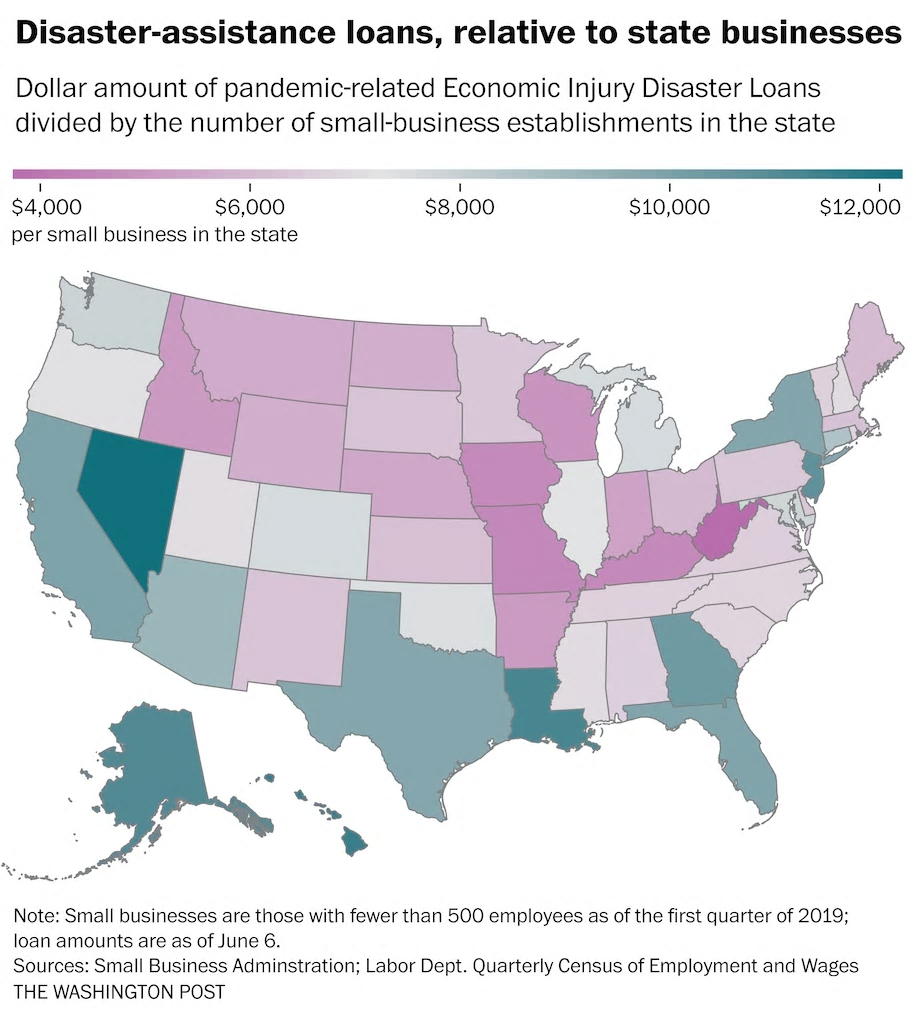
    The $1.9 trillion American Rescue Plan Act of 2021 contains several provisions intended to help small businesses. It authorizes another $7.25 billion for the Paycheck Protection Program, which offers forgivable loans to small businesses and other organizations hurt by the pandemic. Despite the added funds, the legislation does not extend the program which is set to expire on March 31. Groups have been calling on Congress to extend the program or to at least allow the SBA to continue processing loan approvals for applications submitted prior to the deadline. There is also $15 billion added to the Economic Injury Disaster Loan grants program for small businesses in underserved areas, especially those that are minority-owned; $29 billion to create a grant program that provides direct relief to restaurants; another $15 billion for the Shuttered Venue Operators Grants program; and $10 billion to relaunch the State Small Business Credit Initiative.

    * * *


    State Economic Performance

    New Definition for Metropolitan Area Proposed (Office of Management and Budget). The OMB requests public comment on the recommendations it has received from the Metropolitan and Micropolitan Statistical Area Standards Review Committee for changes to OMB’s metropolitan and micropolitan statistical area standards. The proposed changes will impact MSA delineations, increasing the minimum population of cities that constitute the core of Metropolitan Statistical Areas (MSAs) from 50,000 to 100,000. This change would mean a federal redefinition of many existing metro areas across the U.S. A new MSA standard would not just be “statistical” – it would have financial and capacity consequences. Several housing, transportation and Medicare reimbursement programs are tied to communities being metropolitan statistical areas. Also impacted would be CDBG entitlement grants, which go to the central city of every metro area.

    * Economic Outlook *

    COVID-19’s Impact on Potential GDP Growth

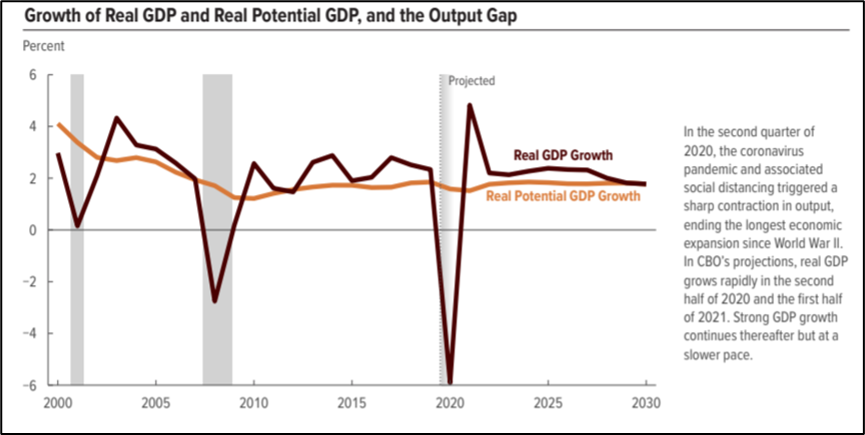
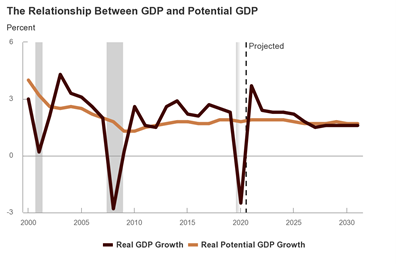
    Early retirement, withdrawal from the labor force due to childcare demands, business closures, and other pandemic-related challenges are likely to hold back labor supply in the near-term, and lengthy school closures may have lowered human capital in the long-term. Productivity may be negatively affected as businesses spend time and resources adjusting to more widespread work from home and social distancing measures. Overall investment has fallen as well, while the increase in investment in IT has mostly gone towards duplicating equipment that currently sits idle in workplace offices. However, Federal Reserve Bank of San Francisco researchers project these effects to be modest over time with little change to the pace of growth of potential GDP, which was subdued even before the downturn due to a slow-growing labor force and limited innovation. In 5 to 10 years post-pandemic, the forecasted GDP growth is just above 1.5%, about the same as pre-pandemic projections.

    * * *

    ___________________________________________________________________________________________________________________________________________________________________________________________________________________________________________________________________________________________________

    Topics and Trends

    Industry Watch

    Manufacturing’s Reshoring Movement (Wealth Management). The pandemic has been disrupting global supply chains since early 2020 and continues to cause frequent delays from international suppliers. Hostile trade relations between the United States and China had been brewing even before COVID-19 hit, accelerating a reshoring trend. Reshoring involves relocating manufacturing assets to the United States from China; more universally, it can include sourcing alternative suppliers in the United States or North America instead of Asia. Reshoring efforts have been gaining momentum and have surged in the face of the trade war and global pandemic. A study by Thomas found that 69% of American companies said they were very likely to bring manufacturing and sourcing back to North America. Tight U.S. industrial real estate capacity, manufacturing labor shortages, technology availability, sustainability initiatives, and reshoring costs can be obstacles. Equipment and other assets must be disassembled and transported or sold and replaced by domestic suppliers. Premises must be built or leased, and a new staff hired and trained. The initial cost is often enough to give companies pause, although many reshoring businesses have turned to logistics partners, consultants, real estate firms, and other specialists to help minimize costs and facilitate easier, more efficient moves.

    Trade/Tariffs

    President Biden’s Trade Policy Agenda (United States Trade Representative). The Office of the United States Trade Representative delivered President Biden’s 2021 Trade Agenda and 2020 Annual Report to Congress, detailing a comprehensive trade policy in support of the Administration’s effort to help the U.S. recover from the COVID-19 pandemic and build back better. The President’s agenda seeks to address four national challenges: building a stronger industrial and innovation base so the future is made in America; building sustainable infrastructure and a clean energy future; building a stronger, caring economy; and advancing racial equity across the board. The trade policy agenda seeks a fair international trading system that promotes inclusive economic growth and reflects America’s universal values. Through bilateral and multilateral engagement, the Biden Administration will seek to build consensus around trade policies that address the climate crisis, bolster sustainable renewable energy supply chains, level the playing field, discourage regulatory arbitrage, and foster innovation and creativity. Trade policy will also value Americans as workers and wage-earners, not only as consumers.

    Opportunity Zones

    Opportunity Zones State of the Marketplace (Economic Innovation Group). A recent report from EIG takes stock of where we are three years after Opportunity Zones were passed into law and one year after final regulations allowed the marketplace to begin to mature. It finds that the OZ concept is largely proving itself in numerous communities across the country, although further legislative and regulatory improvements are necessary to help ensure the policy fulfills its promise. Early results from this new marketplace for investing in struggling American communities vouch for the OZ model. In difficult-to-invest areas, the flexible stake of patient equity capital that OZs unlock can be decisive. Investor behavior is changing as people with capital look at the country’s map in a new light, even if investing through OZ vehicles remains a relatively niche activity. Incremental refinements to the basic OZ structure that simplify investing and bolster both the integrity and transparency of the marketplace would set the policy on a strong course for the duration of this investment window, through 2026.

    The Opportunity Zones program provides a tax incentive for investors to re-invest their unrealized capital gains into Opportunity Funds that are dedicated to investing into Opportunity Zones designated by the chief executives of every U.S. state and territory. Treasury has certified more than 8,700 census tracts as Qualified Opportunity Zones (QOZs) across all states, territories, and the District of Columbia. For a map of all designated QOZs, click here.

    Inclusive Growth

    Indiana’s New Course for Economic Growth and Inclusion (Brookings). According to a Brookings report, Indiana has an opportunity to elevate its economic trajectory. But to do that, the state needs to do more than just manage a serviceable recovery from the immediate COVID-19 shock and recession. Rather, the state needs to address some of the deeper economic challenges it faced prior to the pandemic that could limit the dimensions of its recovery. Indiana should shoot for enhancement—not just repair. The report recommends the state begin improving its standing on key resilience factors by taking action to accelerate technology adoption, facilitate faster industry and worker adaptation, and promote economic inclusion. Along these lines, the state should consider several linked initiatives and action steps, like encouraging digital skills development, addressing a lack of broadband connectivity, promoting advanced industry growth throughout the state, addressing childcare shortages, and enlarging its earned income tax credit, among others.

    Innovation

    Measuring Trends in Artificial Intelligence (Stanford University). Artificial Intelligence (AI) is set to shape global competitiveness over the coming decades, promising to grant early adopters a significant economic and strategic advantage. National governments and regional and intergovernmental organizations have raced to put in place AI-targeted policies to maximize the promise of the technology while also addressing its social and ethical implications. Stanford’s AI Index Report tracks, collates, distills, and visualizes data related to artificial intelligence. Its mission is to provide unbiased, rigorously vetted, and globally sourced data for policymakers, researchers, executives, journalists, and the public to develop intuitions about the complex field of AI. Among the key takeaways in the 2021 Index include: AI investment in drug design and discovery increased significantly; surveillance technologies are becoming fast, cheap, and increasingly ubiquitous; China leads the U.S. in AI journal citations; and most AI PhDs are from abroad and staying in the U.S. to work.

    Infrastructure

    America’s Infrastructure Scores a C- (American Society of Civil Engineers). The American Society of Civil Engineers gives the nation’s infrastructure a C-minus grade on its 2021 infrastructure report card, up from a D-plus four years ago. This is the first time since ASCE began issuing the report card that the nation’s infrastructure has received a GPA above a D. Between 2017 and 2021, five category grades increased while only one—bridges—decreased. This, combined with the commitment from state and local governments to improving infrastructure, indicate that infrastructure investment in the United State is trending upwards. However, 11 of the 17 categories received scores in the ‘D’ range: aviation, dams, hazardous waste, inland waterways, levees, public parks, roads, schools, stormwater, transit, and wastewater. Many sectors, especially those with lower grades, have large maintenance backlogs. The country’s total infrastructure funding gap over the next 10 years is estimated at $2.6 trillion. To close this gap, ASCE calls for strong federal, state, and local leadership and investment in infrastructure. Additionally, resilience must be a priority, as the ability to withstand or recover from extreme events is key to infrastructure survival. State specific infrastructure report cards are also available on the site.

    In infrastructure-related legislation, the U.S. House Energy and Commerce Committee introduced the Leading Infrastructure For Tomorrow’s America Act, or LIFT America Act, which invests more than $312 billion in clean energy, energy efficiency, drinking water, broadband, and health care infrastructure. To view the section-by-section of the bill, click here.

    ________________________________________________________________________________________________________________________________________________________________________________________________________________

    Deal Makers

    Incentives in Action

    Does the American Rescue Plan Act Penalize State Business Incentive Awards?…Maybe? (Good Jobs First). Inside the $1.9 trillion spending plan is a key provision: for every $1 in tax cuts, you lose $1 from what your state is supposed to get. The details are being worked out and the Treasury Department still needs to put out final rules on it, but for groups like Good Jobs First the answer is clear: “Economic development tax breaks should absolutely count.” Indeed, the passage clearly lists new tax credits as a no-no, not just tax cuts. Other groups differ on this interpretation, noting that the provision’s primary purpose is to deter tax cuts that are paid for by Federal funds and not applicable to incentive programs that have a clear state funding source. The ARP Act does appear to throw some uncertainty into ‘unbudgeted’ tax cuts that might be considered by legislatures in the future. Treasury will ultimately weigh in on how economic development tax incentives are handled. States EDOs might consider talking with their state AG and Budget offices to raise awareness on the possible implications. The SEDE Network will continue to monitor developments on this matter.

    * New SEDE Incentives Report *

    Repositioning Economic Development Incentives for 2021

    The latest report from the Center for Regional Economic Competitiveness (CREC) and Smart Incentives provides guidance on critical issues and trade-offs that will help state leaders make sound decisions on incentive policies to generate net benefits for their communities. The guidance draws on lessons learned from past recessions, incentive best practices, recent research examining incentive effectiveness, and responses to economic priorities that have come to the forefront over the last year. The questions in each section provide a framework that will help state leaders assess their incentive options in 2021.

    * * *

    Connecticut Plan for Economic Growth Is Catching On (Site Selection). Plenty of Connecticut businesses are happy to champion the state. They are there because they want to be there, and they believe other companies in their industry would benefit from a Connecticut location as well. This includes corporate executives in three of the state’s leading industries — defense, life sciences and IT. Executives from General Dynamics Electric Boat; Sema4, an AI-driven, patient-centered genomic and clinical data insight platform company; and Infosys, a digital services and consulting firm, each give the state’s overall business climate a high grade for factors like ease of doing business, the regulatory environment, business costs, and access to a quality workforce. The state is placing an increasing emphasis on workforce development as an economic growth strategy, forming an Office of Workforce Strategy and working with community colleges and the Connecticut State Colleges & Universities system to build more certificate programs to provide the skill sets for jobs which are in high demand, such as advanced manufacturing, coding, construction, nursing, and digital media.

    Oklahoma Forms New Statewide EDO (Oklahoma Commerce). Economic developers from across Oklahoma recently convened to form a new corporation, Select Oklahoma an Economic Development Partnership, Inc. The new organization takes the place of the Oklahoma Professional Economic Development Council (OEDC) and the Governor’s Economic Development Marketing Team (GEDMT). Select Oklahoma is chaired by Kinnee Tilly, of the Oklahoma Manufacturing Alliance, and is intended to support statewide efforts to recruit new and retain existing primary jobs and capital investment in the state. In addition to marketing efforts, the corporation will support a healthy economy for the State through legislative advocacy, education, training and development and professional collaboration. “The creation of this organization will allow us to better engage with communities in all 77 counties and speak with one voice as we strive to be a Top Ten State in economic growth,” said Oklahoma Department of Commerce Executive Director Brent Kisling.

    The State Business Incentives Database is a national database maintained by the Council for Community and Economic Research (C2ER) with almost 2,000 programs listed and described from all U.S. states and territories. The Database gives economic developers, business development finance professionals, and economic researchers a one-stop resource for searching and comparing state incentive programs. To view the information available in the database, click here.

    New Growth Opportunities

    Jobs and Skills Driving the Post-Pandemic Recovery (Burning Glass Technologies). The recession left in the wake of the COVID-19 pandemic is unprecedented. If the U.S. is going to have a recovery that not only brings the economy back to where it was but also ensures a more equitable future, it is crucial to understand what jobs and skills are likely to drive the recovery. In this report, Burning Glass Technologies uses a database of more than 1 billion current and historical job postings, along with expert views, to anticipate what jobs will be most important in the post-pandemic labor market. The report projects jobs in the Readiness, Logistics, Green, Remote, and Automated economies will grow at almost double the rate of the job market overall in coming years. These jobs already represent significant fractions of the labor market and are important inflection points for the economy. A shortage of talent in these fields could set back the broader recovery.


    Talent Development/Attraction

    The Robots Are Coming for Phil in Accounting (New York Times). White-collar workers, armed with college degrees and specialized training, once felt relatively safe from automation. But recent advances in AI and machine learning have created algorithms capable of outperforming doctors, lawyers, and bankers at certain parts of their jobs. And as bots learn to do higher-value tasks, they are climbing the corporate ladder. The trend — quietly building for years but accelerating to warp speed since the pandemic — goes by the sleepy moniker “robotic process automation.” And it is transforming workplaces at a pace that few outsiders appreciate. Nearly 8 in 10 corporate executives surveyed by Deloitte last year said they had implemented some form of R.P.A. Another 16 percent said they planned to do so within three years. Executives generally spin these bots as being good for everyone, “streamlining operations” while “liberating workers” from mundane and repetitive tasks. But they are also liberating plenty of people from their jobs. Independent experts say that major corporate R.P.A. initiatives have been followed by rounds of layoffs, and that cutting costs, not improving workplace conditions, is usually the driving factor behind the decision to automate.

    Counting U.S. Postsecondary and Secondary Credentials (Credential Engine). Learners, educators, and policymakers understand that high school completion and education beyond high school are critical to success in the workforce. However, the marketplace of credentials, education, and training in the United States is vast, complex, expensive, inefficient, and until recently, an inventory did not exist of the number or type of secondary and post-secondary credential opportunities in the United States. This is the third annual report from Credential Engine that attempts to count all these credentials. The report identifies nearly one million unique credentials in the U.S. in 16 detailed credential categories across four types of credential providers—postsecondary educational institutions, Massive Open Online Course (MOOC) providers, non-academic organizations, and secondary schools. New in this report is a state-by-state breakdown of credentials offered by state-based entities in five categories: diplomas, certificates, degrees, apprenticeships, and licenses.


    * * *

    SEDE Network Updates

    * Recording Available *

    Incentives Roundtable: Remote Workers Impact on Compliance

    Click to Listen

    Listen to the March 16, 2021 discussion, hosted by SEDE and CREC, on how remote work became a more important part of the economic landscape in 2020. In response, many state economic development organizations are considering the impact of remote work on existing incentive performance agreements as companies endeavor to remain compliant with the terms of their contracts. Now that compliance reporting deadlines are approaching, the discussion included suggestions on how economic development organizations can adjust incentive program compliance procedures in response to last year’s upheavals. Ellen Harpel, Founder of Smart Incentives, and Jane Vancil, CEO of IncentiLock, facilitated the discussion held via Zoom.

    Speakers:


    * * *

    The SEDE Network Steering Committee includes: Stefan Pryor (RI), Chair; Sandra Watson (AZ), Vice Chair; Julie Anderson (AK); Mike Preston (AR); Kurt Foreman (DE); Don Pierson (LA); Kelly Schulz (MD); Kevin McKinnon (MN); Chris Chung (NC); Alicia Keyes (NM); Michael Brown (NV); Andrew Deye (OH); Dennis Davin (PA); Jennifer Fletcher (SC); Adriana Cruz (TX); Joan Goldstein (VT); Mike Graney (WV).

    For further questions on the content in this Bulletin or for information on the SEDE Network contact Marty Romitti, CREC Senior Vice President, at mromitti@crec.net

  • State Economic Development Bulletin – February 2021

    State Economic Development Bulletin – February 2021

    Latest News

    What to Watch in the 2021 Stimulus Proposal (SEDE Staff). The American Rescue Plan proposed by President Biden and currently being considered in the U.S. House would provide $1.9 trillion in economic relief. While the proposed $1,400 stimulus checks and the national vaccination plan are getting most of the headlines, the plan has quite a few other items to help small businesses and support intermediaries in struggling communities. Nine House Committees are completing their mark-up of bills associated with the American Rescue Plan proposal. SEDE staff reviewed the plan and summarized provisions particularly relevant to business and workforce agencies. The plan is intended to give pandemic-impacted Americans and the overall U.S. economy a boost. Current Congressional Budget Office projections expect the economy to strengthen during the next five years. The annual growth of real GDP averages 2.6 percent during the five-year period, exceeding the 1.9 percent growth rate of real potential GDP.

    * Recent Release *

    Federal Resources for State and Local Economic Development

    Congress has authorized over 130 economic development programs administered by over 20 departments and agencies. These programs support efforts to improve job opportunities, tax bases, individual or community wealth, and quality of life measures; contribute to economic growth; create reinforcing industrial clusters; and reduce economic inequality. In contrast to centrally-planned approaches, most federal programs in the United States are designed to strengthen the national economy by supporting the plans and strategies established by state and local stakeholders. The range of economic development programs approved by Congress reflects shifting priorities, changing global market trends, and a variety of theories about what drives local and regional economies.


    State Economic Performance

    Metropolitan Area Employment Down in 232 Areas (Bureau of Labor Statistics). From December 2019 to December 2020, nonfarm payroll employment decreased in 232 metropolitan areas, increased in 2 areas, and was essentially unchanged in 155 areas. The largest over-the-year percentage losses in employment occurred in Kahului-Wailuku-Lahaina, Hawaii (−22.4 percent), Monroe, Michigan (−16.4 percent), and Flagstaff, Arizona (−15.1 percent). Over-the-year increases in employment occurred in Ogden-Clearfield, Utah (+8,100, or +3.0 percent), and Idaho Falls, Idaho (+3,100, or +4.9 percent). These data are from the Current Employment Statistics (CES) program which produces detailed industry estimates of employment, hours, and earnings of workers on nonfarm payrolls for all 50 States, the District of Columbia, Puerto Rico, the Virgin Islands, and about 450 metropolitan areas and divisions.


    * Economic Outlook *

    COVID-19 and State and Local Budgets

    State and local governments are a major piece of the U.S. economy, accounting for about 13 percent of all employment. They typically have balanced budget requirements, which mean that shortfalls in revenues triggered by the pandemic must be offset with spending cuts or tax increases—actions which hurt taxpayers and impede the economic recovery. The December 2020 COVID relief package approved by Congress provides roughly $125 billion to state and local governments for education, health, public transit, and highways, but does not include any general aid to states or localities to cover revenue losses. These governments continue to face higher demands on spending due to the pandemic, and revenue losses in some states are likely to exceed any federal aid received. This webinar held at the Municipal Finance Conference discusses the outlook for state and local revenues in the coming years.

    * * *

    ___________________________________________________________________________________________________________________________________________________________________________________________________________________________________________________________________________________________________

    Topics and Trends

    Industry Watch

    Sporting Goods Industry Trends in 2021 (McKinsey & Company). In 2020, the sporting goods industry contracted for the first time since the financial crisis of 2007–08. Most brands, retailers, and manufacturers finished the year significantly in the red, except for the Chinese market which continued as the industry’s growth engine. Specific sports were impacted to varying degrees by the pandemic, depending on how accessible they were in a locked-down environment. Outdoor individual sports and home workouts both saw increased participation. Team sports and indoor sports struggled. Among emerging opportunities, women’s clothing with the increased focus on home workouts, running, yoga, and Pilates. However, the impact of the pandemic goes beyond temporary performance—it has ushered in the next normal for the industry, defined by factors including digital commerce, rising demand for sustainable products, and increasing participation in individual forms of sports and exercise. To win in the new environment, the industry needs to adapt both its customer proposition and its operational capabilities.

    Trade/Tariffs

    What’s Ahead for US Trade Policy in 2021 (Industry Week). President Biden has been clear that it will take a multilateral approach to addressing trade issues associated with China. It is anticipated that any de-escalation or removal of Section 301 or Section 232 tariffs will be implemented in phases and in cooperation with allies. There is still widespread support in the U.S. business community for maintaining an aggressive stance against China on intellectual property, technology, and investment issues. On the other hand, there have been numerous complaints that the tariffs on covered products from China are injuring them and that the exclusion process has been less than opaque. Thus, there seems to be a real possibility of reopening the product exclusion process in a more transparent manner, which could result in granting additional exclusions. This year will likely bring a continued uptick in enforcement actions for evading or circumventing antidumping and countervailing duties. The Biden Administration will also enjoy latitude in determining, through Commerce Department regulations, if or how to regulate exports of “emerging and foundational technologies” as required under the Export Control Reform Act of 2018.

    Opportunity Zones

    New IRS Deadlines for Opportunity Zones (USA Today). Citing the impact of COVID-19 on individuals and businesses, the IRS issued Notice 2021-10 on Jan. 19, 2021, pushing out OZ investor deadlines that already had been extended to the end of 2020. This includes the 180-day deadline for new investments into QOFs until March 31, 2021, and relief from the 90% investment test to June 30, 2021. Among other Notice 2021-10 extensions—a QOF must generally hold 90% qualified OZ property at each six-month testing date, but for calendar 2021, the test will be turned off for most QOFs, provided the fund can show “reasonable cause” for the failure to meet the test. The new notice also allows another three months through March 31, 2021, for taxpayers who generated “direct” or indirect (e.g., K-1) gains with an original 180-day reinvestment deadline on or after April 1, 2020. The notice also delays the effective dates of the 30-month substantial improvement period for the period beginning on April 1, 2020 and ending on March 31, 2021. Like many of the extensions in the latest notice, this provision extends relief from IRS Notice 2020-39 issued last June. To read IRS Notice 2021-10, click here.

    Opportunity Funds Top $15 Billion in 2020 (Novogradac). Three years after the passage of legislation creating the OZ incentive, investment surpassed $15 billion as of the end of 2020. The latest data from the Novogradac Opportunity Zones Investment Report–reported equity raised of $15.16 billion by Qualified Opportunity Funds (QOFs). The raised equity continues to focus largely on residential and commercial investment. QOFs that report at least some focus on residential properties account for $11.91 billion in equity investment (78.5% of the total) while commercial-focused QOFs account for $9.37 billion (61.8% of the total). Since many QOFs report a focus on multiple areas the total is more than 100%. Hospitality, renewable energy, and operating businesses make up the other areas of investment, in order of investment. For more information on Opportunity Zones, CDFA has extensive resources available, click here.

    The Opportunity Zones program provides a tax incentive for investors to re-invest their unrealized capital gains into Opportunity Funds that are dedicated to investing into Opportunity Zones designated by the chief executives of every U.S. state and territory. Treasury has certified more than 8,700 census tracts as Qualified Opportunity Zones (QOZs) across all states, territories, and the District of Columbia. For a map of all designated QOZs, click here.

    Inclusive Growth

    Uplifting America’s Left Behind Places (Economic Innovation Group). The longest economic expansion in U.S. history, from June 2009 to February 2020, failed to reach many communities across the country. By placing geographic inequality at the heart of the domestic policy agenda, a new administration and Congress have a chance to recalibrate the federal approach to economic development and directly empower more Americans to participate in the country’s growth and thrive. EIG’s framework for place-conscious policymaking includes the establishment of a centralized entity to bring strategic direction to federal economic development policy, such as an empowered Economic Development Administration or a new cabinet-level entity. It also recommends to routinely assess the likely geographic impact of policies; commit to a U.S. Domestic Development Corporation that expands the finance toolkit; improve access to capital in distressed, disinvested communities; bolster capacity and connectivity; invest in people and families to boost local human capital; and reinvigorate competition to support startup formation and worker mobility.

    Innovation

    Iowa Plans for Manufacturing 4.0 (Iowa Economic Development Authority). Manufacturing faces a technology revolution that emphasizes automation and smart technology. This fourth Industrial Revolution, known as Industry 4.0, will usher in advances and disruptions to manufacturing on a similar scale as those brought over time by water and steam power, mass assembly and computing and robotics. Industry 4.0 includes the Internet of Things, additive manufacturing, advanced robotics, augmented reality and cybersecurity. Digital technologies may not replace jobs, but they will transform how work is performed – how products are designed, fabricated, used, and serviced. The ability for states like Iowa to compete globally will hinge on successful transitions to new operating models, especially for small-to-medium sized manufacturers. Iowa Economic Development Authority’s (IEDA) Iowa Innovation Council led the Manufacturing 4.0 plan with a focus on advancing technology adoption and utilization among Iowa’s manufacturers; it further addresses enhancements in the broader manufacturing ecosystem.

    Infrastructure

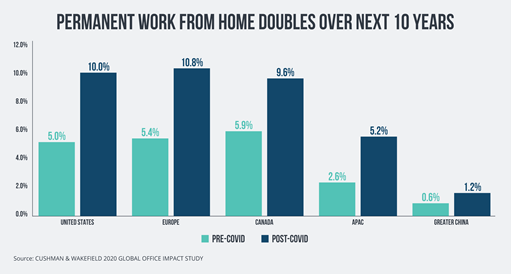
    The Road Ahead for Commercial Office Space (Cushman & Wakefield). In 2020, there was 104 million square feet of negative commercial office space absorption, which is more severe than during the Great Recession. Sublease space soared—about 50% of the negative absorption came from newly added sublet space. Office vacancies rose from 12.9% pre-pandemic to 15.5% by year-end. When lining up the office-using job losses that occurred last year (1.15 million) with the amount of negative absorption, it suggests that vacancy will continue to rise—at least for the next couple of quarters—as businesses continue to right-size office footprints and Work from Home trends filter through. However, there is no evidence thus far that businesses are leaving large cities. In a typical year, about one-third of all office leasing in the U.S. occurs in gateway cities (Boston, Chicago, Washington, DC, Los Angeles, New York, San Francisco), and in 2020, it was about the same, 32%. Likewise, office sales activity was down sharply virtually everywhere in 2020 but down equally in major markets and non-major markets.

    ________________________________________________________________________________________________________________________________________________________________________________________________________________

    Deal Makers

    Incentives in Action

    How States Can Direct Economic Development to Places and People in Need (Pew Charitable Trusts). States play a central role in place-based development efforts, helping to administer major federal economic and community development programs, designing their own initiatives, and writing laws that dictate how local government programs may operate. In this report, Pew recommends that states should: target programs using quantitative measures; systematically assess geographic targeting; regularly update the set of eligible locations; tailor economic development strategies to local needs; and create job opportunities for low-income residents. By following these recommendations, states can help to ensure that place-based economic development programs help combat poverty, joblessness, and disinvestment in some of America’s poorest communities.

    State Small Business Credit Initiative (SSBCI) 2.0 Introduced (Council of Development Finance Agencies). Michigan Senators Peters and Stabenow have introduced a bill in the U.S. Senate to reauthorize the State Small Business Credit Initiative (SSBCI). CDFA has worked closely with these offices to stress the importance of recapitalizing state programs that had expired in 2017 to bring immediate support to small businesses hurt by the COVID-19 coronavirus pandemic. The State Small Business Credit Initiative (SSBCI) was a federal financing program that delivered flexible, affordable capital to small businesses around the country. The expiration of the SSBCI Program in 2017 left a void in the marketplace for affordable small business loans. Senate Bill 258 would provide $10 billion in funds to a reauthorized SSBCI Program. The programs created by states under the original SSBCI are still in operation and would be ready to immediately deploy capital to businesses in need. To track S. 258, click here.

    Maryland Helps Medical Testing Company Expand (Maryland Department of Commerce). Dutch medical testing company Qiagen, which has seen huge demand for its COVID-19 test kits, is expanding its manufacturing operations in Montgomery County, Maryland. Qiagen’s U.S. headquarters and research and development manufacturing facility is in Germantown (MD). It plans to renovate its 146,000-square-foot manufacturing facility there to accommodate expanding production of its testing products for COVID-19 and other diseases. It has already added around 80 contract workers and invested $7 million in building renovations and equipment. The company will further increase investments and add jobs to its more than 300 employees in Montgomery County, and lease additional space in the area. Qiagen has received state and county incentives for its expansion, including a $1 million loan contingent on job creation and investment from the Maryland Department of Commerce and a $100,000 workforce training grant from the state. Montgomery County has also approved a $100,000 grant, contingent on job creation and investment.

    The State Business Incentives Database is a national database maintained by the Council for Community and Economic Research (C2ER) with almost 2,000 programs listed and described from all U.S. states and territories. The Database gives economic developers, business development finance professionals, and economic researchers a one-stop resource for searching and comparing state incentive programs. To view the information available in the database, click here.

    New Growth Opportunities

    U.S. Heartland States Poised for Industrial Resurgence with Reshoring (Heartland Forward). The U.S. is poised for an industrial comeback led by the Heartland and fueled by reshoring, the return of manufacturing centers to the U.S. from abroad. A recent Heartland Forward report notes growing bipartisan support for policies that bring foreign businesses home, as the Biden administration works to promote domestic manufacturing and Congress grapples with the country’s dependence upon Chinese-made personal protective equipment (PPE) during the pandemic. In a 2020 survey, 70 percent of firms say they will likely reshore in the coming years. Heartland states stand to benefit the most from reshoring activity, given the concentration and diversity of its existing manufacturing base, skilled labor pool and training programs, proximity to domestic suppliers, as well as infrastructure to support production facilities. The growth of financial and professional services in the Heartland also makes it a desirable place for manufacturers, given the shift within the industry toward outsourcing these aspects of the business.

    Talent Development/Attraction

    Union Membership Rates in 2020 (Bureau of Labor Statistics). In 2020, 30 states and the District of Columbia had union membership rates below the U.S. average, 10.8 percent, while 20 states had rates above it. Nine states had union membership rates below 5.0 percent. South Carolina had the lowest rate (2.9 percent). The next lowest rates were in North Carolina and Utah (3.1 percent and 3.7 percent, respectively). Two states had union membership rates over 20.0 percent: Hawaii (23.7 percent) and New York (22.0 percent). Over half of the 14.3 million union members in the United States lived in just seven states (California, 2.4 million; New York, 1.7 million; Illinois and Pennsylvania, 0.7 million each; and Michigan, New Jersey, and Ohio, 0.6 million each). These data are from the Current Population Survey.

    Online Job Search and Recruiting Tools and Job Match Quality (IZA Institute of Labor Economics). The advent of the internet has fundamentally changed the way workers and employers search for each other and eventually form a match. This trend is mirrored by the increased use of online search and recruiting tools by individual job seekers and employers. Given these developments, a question of particular interest is whether search via the internet along with the improved market information help to establish better matches in the labor market. This study results show that internet availability has no major impact on the stability of new matches and their wages. The study uses vacancy data, by explicitly comparing match outcomes of online and non-online recruits. Further results show that online recruiting not only raises the number of applicants and the share of unsuitable candidates per vacancy, but also induces employers to post more vacancies.


    * * *

    SEDE Network Updates

    * Upcoming SEDE Roundtable *

    Incentives Roundtable: Remote Workers Impact on Compliance

    Tuesday, March 16, 2021

    2:00 PM – 3:00 PM ET

    Register

    Remote work became a more important part of the economic landscape in 2020. In response, many state economic development organizations are considering the impact of remote work on existing incentive performance agreements as companies endeavor to remain compliant with the terms of their contracts. Now that compliance reporting deadlines are approaching, how should economic development organizations adjust incentive program compliance procedures in response to last year’s upheavals?

    Join CREC and Roundtable leaders Ellen Harpel, Founder, Smart Incentives and Jane Vancil, CEO, IncentiLock on March 16 for a 60-minute presentation and discussion. This event will be held on Zoom.

    Speakers:


    * * *

    The SEDE Network Steering Committee includes: Stefan Pryor (RI), Chair; Sandra Watson (AZ), Vice Chair; Julie Anderson (AK); Mike Preston (AR); Kurt Foreman (DE); Don Pierson (LA); Kelly Schulz (MD); Kevin McKinnon (MN); Chris Chung (NC); Alicia Keyes (NM); Michael Brown (NV); Andrew Deye (OH); Dennis Davin (PA); Jennifer Fletcher (SC); Adriana Cruz (TX); Joan Goldstein (VT); Mike Graney (WV).

    For further questions on the content in this Bulletin or for information on the SEDE Network contact Marty Romitti, CREC Senior Vice President, at mromitti@crec.net

  • State Economic Development Bulletin – January 2021

    State Economic Development Bulletin – January 2021

    Latest News

    Trends for 2021—and Beyond (McKinsey & Company). Businesses have spent much of the past nine months scrambling to adapt to extraordinary circumstances. While the fight against the COVID-19 pandemic is not yet won, with a vaccine in sight, there is at least a faint light at the end of the tunnel—along with the hope that another train is not heading our way. 2021 will be the year of transition. Barring any unexpected catastrophes, individuals, businesses, and society can start to look forward to shaping their futures rather than just grinding through the present. The next normal is going to be different. It will not mean going back to the conditions that prevailed in 2019. Indeed, just as the terms “prewar” and “postwar” are commonly used to describe the 20th century, generations to come will likely discuss the pre-COVID-19 and post-COVID-19 eras.

    SBA and Treasury Announce PPP Re-Opening (U.S. Small Business Administration). The U.S. Small Business Administration (SBA), in consultation with the Treasury Department, announced that the Paycheck Protection Program (PPP) will re-open beginning the week of January 11, 2021 for new borrowers and certain existing PPP borrowers. To promote access to capital, initially only community financial institutions will be able to make First Draw PPP Loans on Monday, January 11, and Second Draw PPP Loans on Wednesday, January 13. The PPP will open to all participating lenders shortly thereafter. Updated PPP guidance outlining Program changes to enhance its effectiveness and accessibility was released in early January 2021 in accordance with the Economic Aid to Hard-Hit Small Businesses, Non-Profits, and Venues Act.


    State Economic Performance

    Lowest Population Growth in U.S. History Recorded (Brookings). Newly released Census Bureau population estimates through mid-year 2020 reveal record lows in U.S. population growth, both annually and for the 2010-to-2020 decade. The new estimates indicate that over the period from July 1, 2019 to July 1, 2020, the nation grew by just 0.35%. This is the lowest annual growth rate since at least 1900. The new data also shows that when the 2020 census numbers are announced, the 2010-to-2020 decade growth rate could be the lowest in any decade since the first census was conducted in 1790. These statistics paint a portrait of a nation that is experiencing unprecedented growth stagnation, even before the COVID-19 pandemic hit. The exceptionally low growth rate from 2019 to 2020 reflects the pandemic’s impact over part of that year. The new statistics also provide estimates of state-level population growth between 2010 and 2020. With this, the projected Congressional reapportionment shows two states—Texas (+3) and Florida (+2)—would gain multiple seats. Five others—all in the West (Arizona, Colorado, Oregon, and Montana) and South (North Carolina)—gain one.

    * Fact Sheet *

    President Biden Announces American Rescue Plan

    President Joe Biden unveiled a $1.9 trillion coronavirus plan to speed up vaccines and deliver help to those struggling with the pandemic’s prolonged economic fallout. Called the “American Rescue Plan,” the legislative proposal would meet Biden’s goal of administering 100 million vaccines by the 100th day of his administration and advance his objective of reopening most schools by the spring. It also delivers another round of aid to stabilize the economy. Under Biden’s multipronged strategy, about $400 billion would go directly to combating the pandemic, while the rest is focused on economic relief and aid to states and localities. Presidential Inauguration Day marks the anniversary of the first confirmed case of COVID-19 in the United States. To read the full AP story, click here

    * * *


    Topics and Trends

    Industry Watch

    Deep Aviation Industry Losses to Continue (International Air Transport Association). Airline financial performance is expected to see a significant turn for the better in 2021, even if historically deep losses prevail. The expected $38.7 billion loss in 2021 will be second only to 2020 performance. On the assumption that there is some opening of borders by mid-2021 either through testing or growing availability of a vaccine, overall revenues are expected to grow to $459 billion ($131 billion above 2020 but still 45% below 2019). In comparison, costs are only expected to rise by $61 billion, delivering overall improved financial performance. Passenger numbers are expected to grow to 2.8 billion in 2021. That would be a billion more travelers than in 2020, but still 1.7 billion travelers short of 2019 performance. Airlines will still lose, however, $13.78 for each passenger carried. By the end of 2021 stronger revenues will improve the situation, but the first half of next year still looks extremely challenging. North American airlines are expected to benefit from an earlier recovery in the U.S. domestic market (the largest domestic market in the world) and have already restructured more extensively than other regions of the world which supported their pre-crisis industry-leading financial performance.

    Trade/Tariffs

    Europe after Germany’s Merkel (Eurasia Group). Without German Chancellor Angela Merkel’s deft political skills, the European Union (EU) would have faced an unprecedented internal split between Poland and Hungary on the one hand, and the remaining 25 member states on the other. The continent’s economic recovery would have hung in the balance, with far more pressure on the European Central Bank. Merkel set the stage for the EU to secure its landmark €750 billion recovery fund, a game-changing development that represented the best (and perhaps only) use of the pandemic as a political opportunity for strengthening multilateralism. She also managed to conclude a trade agreement with the U.K. and an investment deal with China, both of whose real value is the framework and basis for broader political and strategic cooperation they provide. In short, Merkel has been Europe’s most important leader. Her departure later in 2021 after 15 years as chancellor drives the continent’s top risk with potential impacts on U.S. relations and trade as well.

    Opportunity Zones

    Opportunity Zones Could Boom In 2021 (Forbes). While the Opportunity Zone program was created by the Tax Cuts and Jobs Act of 2017, which passed without any Democratic support, the opportunity zone idea has bipartisan roots. That crucial cross-aisle appeal, combined with the potential for increased regulatory clarity, possible tax rate increases, the massive gains of the unprecedented bull market of the last decade-plus, and the economic devastation in cities from Covid-19 have all set the stage for what could be a long-anticipated rush to opportunity zones. President Biden was vocal on the campaign trail about looking to rein in the program, with critics seeing it as having lax regulations and being poorly targeted. But the President has also signaled support for the program, including bringing into his administration members of the previous two administrations who were some of the original architects of the program. In other words, the potential exists for a more regulated, targeted, and monitored version of opportunity zones to take off in 2021. To view the Final Regulations on Opportunity Zones issued by the U.S. Treasury Department and IRS, click here.

    Experts Share Perspectives on OZ Program Performance (Multi-Housing News). Opportunity Zones are a good idea today more than ever because they allow investors to “do well by doing good,” making an impact while seeing a return. There is a misperception that geography drives outcomes and certain locations are “bad places” to invest money. Opportunity Zones show that good projects can be viable investment opportunities regardless of the location. Successful projects must be carefully planned and well thought-out, like any venture. Some of the nonmajor metro centers, such as Birmingham (AL), Baltimore and Cleveland to name a few, have the most potential impact from the Opportunity Zones program and have garnered interest from investors. Some grew up in the region and are personally invested in giving back. These are among the observations by Ira Weinstein and Steve Glickman, co-authors of “The Guide to Making Opportunity Zones Work.” For more information on Opportunity Zones, CDFA has extensive resources available, click here.

    The Opportunity Zones program provides a tax incentive for investors to re-invest their unrealized capital gains into Opportunity Funds that are dedicated to investing into Opportunity Zones designated by the chief executives of every U.S. state and territory. Treasury has certified more than 8,700 census tracts as Qualified Opportunity Zones (QOZs) across all states, territories, and the District of Columbia. For a map of all designated QOZs, click here.

    Inclusive Growth

    Many Businesses Paid Non-Working Employees during COVID–19 (Bureau of Labor Statistics). About half of U.S. business establishments continued to pay at least some of their employees told not to work due to the COVID–19 pandemic. When employers who told employees not to work received a loan or grant tied to rehiring or maintaining employees on their payroll, 59 percent continued to pay employees who were told not to work. Only 38 percent of businesses that did not receive a loan or grant continued to pay employees told not to work. Larger businesses were more likely to continue paying employees told not to work than were smaller businesses. These data are from the Business Response Survey to the Coronavirus Pandemic, a new BLS survey that asks questions on business experiences and responses to the COVID-19 pandemic.

    Innovation

    Reinventing the PPE Supply Chain in the Face of COVID-19 (Manufacturing USA). With so much production of personal protective equipment (PPE) focused in Asia, when the pandemic started it created a ripple effect on U.S. manufacturers that revealed issues in the supply chain. It particularly showed a lack of redundancy and transparency in the supply chain, and that the PPE supply chain in the U.S. would need reinventing. This article highlights the work by Manufacturing USA, a network of 16 institutes and their sponsoring federal agencies — the Departments of Commerce, Defense and Energy, in strengthening domestic PPE manufacturing. Mapping the PPE Supply Chain was one effort, among others. The conclusion from the network’s research is that there is a clear ROI for manufacturing PPE in the U.S. both economically and for society. Manufacturers already were dealing with risks of cost-driven outsourcing — such as poor quality, theft of IP, shipping delays and a lack of control — so the pandemic may prove to be a tipping point for reshoring. Emerging technologies are also converging with this demand to create new possibilities for domestic manufacturing.


    Infrastructure

    States Prioritized Broadband as COVID-19 Took Hold (Government Technology). COVID-19 forced government to leave behind its offices, schools to close their doors and citizens to isolate themselves at home. In doing so, the pandemic more than underlined the digital haves and have-nots, as a large segment of the American population has had to grapple with the demands of telework, distance learning and accessing online services. State leaders, no matter their political affiliation, acknowledged the digital divide more than ever before in 2020 and took different steps to facilitate more broadband. Mississippi awarded $65 million of its CARES Act money to electric cooperatives working on fiber buildouts, Indiana dedicated $51 million to its Next Level Connections Broadband Grant Program and Delaware is using $20 million of its CARES Act funding to address multiple digital equity concerns. Moreover, several states, including Alabama and Washington, began conducting surveys to gauge broadband levels within their borders. Continued action at the state level is likely, though the funding picture going into 2021 means the work will depend on additional federal support. The private sector will also play a significant role in the ongoing broadband movement.


    Deal Makers

    Incentives in Action

    * New SEDE Incentives Report *

    Addressing Remote Work in State Business Incentive Programs

    As remote work became a more important part of the economic landscape in 2020, state economic development leaders considered adjustments to incentive programs to acknowledge this shift. Several states are addressing remote work in existing incentive performance agreements as companies strive to remain compliant with the terms of their contracts. Others are making permanent changes to their incentive policies as a strategic response to the expectation that remote work will become more widespread. Many more states are still sorting through the implications of remote work for their companies and communities. This paper addresses the issues state economic development organizations should consider as they determine whether or how to adjust their incentive programs to accommodate remote work. This is the fifth report in a series of timely papers on state incentives management completed by CREC and Smart Incentives for the SEDE network. The entire series is available on the SEDE website, click here.

    Michigan Reinstates State Historic Tax Credit (Upper Peninsula MI Matters). Michigan Governor Whitmer signed legislation that reinstates the state historic tax credit (HTC) through the end of 2030. S.B. 54 grants a state HTC for 25% of qualified rehabilitation expenses, with an annual statewide cap of $5 million and a per-taxpayer cap of $2 million. The legislation sets aside $2 million annually for large nonresidential historic resources, $2 million for small nonresidential historic resources, and $1 million for residential historic resources. The credit is effective for taxpayers who receive a certificate of completed rehabilitation after Dec. 31, 2020. Michigan’s previous state HTC expired in 2012. The tax credit comes back to eligible taxpayers when they file their income taxes for the year. If it is not used in the first year after they complete their restoration, it can be used up to ten years. One user of the incentive indicated the tax credit was enough to impact whether they chose new shingles with a longer lifespan or not.

    New York Creates Restaurant Survival Loan Fund (Empire State Development). The Raising the NYS Bar Restaurant Recovery Fund offers ​approximately $3 million in reimbursement grants for up to $5,000 to eligible businesses. The program is intended to support full-service restaurants – the industry hit hardest by the pandemic – during the winter months when outdoor dining is limited and as restaurants adjust to New York State’s COVID-19 safety restrictions and new mandates. The fund is a partnership between New York State, Diageo Wine & Spirits, Southern Glazer Wines & Spirits and The National Development Council (NDC). NDC will manage the grant funding. Grants are supplied on a reimbursement basis to restaurants operating in the state on or before March 1, 2019 and classified in NAICS code 722511, or establishments engaged in providing food services and meals prepared on-premises to patrons who traditionally order and are served while seated (i.e., waiter/waitress service), those licensed through the State Liquor Authority (SLA), and those providing take out or grab and go food services due to COVID-19 restrictions. Franchises are not eligible.

    The State Business Incentives Database is a national database maintained by the Council for Community and Economic Research (C2ER) with almost 2,000 programs listed and described from all U.S. states and territories. The Database gives economic developers, business development finance professionals, and economic researchers a one-stop resource for searching and comparing state incentive programs. To view the information available in the database, click here.

    New Growth Opportunities

    Wisconsin Releases Rural Prosperity Report with Actions (Wisconsin Economic Development Corporation). The Wisconsin Governor’s Blue Ribbon Commission on Rural Prosperity has released “Rural Voices for Prosperity,” which calls for coordinated measures across state government to meet the needs of Wisconsin’s rural communities. The report features 10 overarching recommendations that, taken together, would commit state government to a comprehensive approach to rural prosperity, create new partnerships with rural and tribal communities in designing and delivering state services, and investing more thoughtfully to address rural Wisconsin’s critical challenges and most promising opportunities. Among the recommendations is for the state to partner with UW-Extension to help regions understand assets and craft development strategies that incorporate rural realities; continue to support the work of WEDC’s Office of Rural Prosperity, and to look beyond Wisconsin’s borders for good ideas.

    Talent Development/Attraction

    Talent Attraction Strategies for 2021 (EMSI). Talent attraction and development is driven by a few core principles: coordinate and collaborate, follow the lead of business, and focus on skills. While the COVID-19 pandemic altered life and the economy in 2020, and will have lasting impacts, these principles of talent attraction and development remain unchanged. To address immediate needs and capture current opportunities, near-term strategies can be adapted to current market trends. Likewise, long-term strategies can be tweaked to reflect the realities of a post-COVID world. While enticing working-age adults to a region gets the limelight in talent attraction and much of talent development is focused on the certificate and degree programs, to cultivate a healthy stream of talent you need to start earlier than either of these phases. This means thinking about students at each stage of their education and training. The fruits of these labors will take time to reap but are the necessary foundation for a resilient workforce over the long term.

    Lessons Earned: Putting Education to Work (Strada Education Network). In the not-so-distant future, workers will make dozens of career changes over a working life of 75 or even 100 years. Michelle Weise, an expert on the future of work and author of “Long Life Learning,” says human skills like creativity, communication, and teamwork will remain critical in an era when robots and automation take over routine jobs. What is more, workers increasingly will need to learn new skills rather than assuming a degree early in life will carry them through. This podcast is part of a series on Lessons Earned hosted by the Strada Education Network. In each episode, the podcast host sits down with educators, employers, and policymakers who are challenging the status quo and exploring bold new ideas to help millions of Americans navigate between learning and earning.


    * * *

    SEDE Network Updates

    * Check out the SEDE Website *

    StateEconomicDevelopment.org

    The SEDE Network engages in regular activities and events throughout the year. You can stay up to date on all these activities via the SEDE Network website. The site includes a collection of websites and other resources used by states to address the Coronavirus Challenge.

    Click the link above and check it out!


    * * *

    The SEDE Network Steering Committee includes: Stefan Pryor (RI), Chair; Sandra Watson (AZ), Vice Chair; Julie Anderson (AK); Mike Preston (AR); Kurt Foreman (DE); Don Pierson (LA); Kelly Schulz (MD); Kevin McKinnon (MN); Chris Chung (NC); Alicia Keyes (NM); Michael Brown (NV); Andrew Deye (OH); Dennis Davin (PA); Jennifer Fletcher (SC); Adriana Cruz (TX); Joan Goldstein (VT); Mike Graney (WV).

    For further questions on the content in this Bulletin or for information on the SEDE Network contact Marty Romitti, CREC Senior Vice President, at mromitti@crec.net

  • State Economic Development Bulletin – December 2020

    State Economic Development Bulletin – December 2020

    Latest News

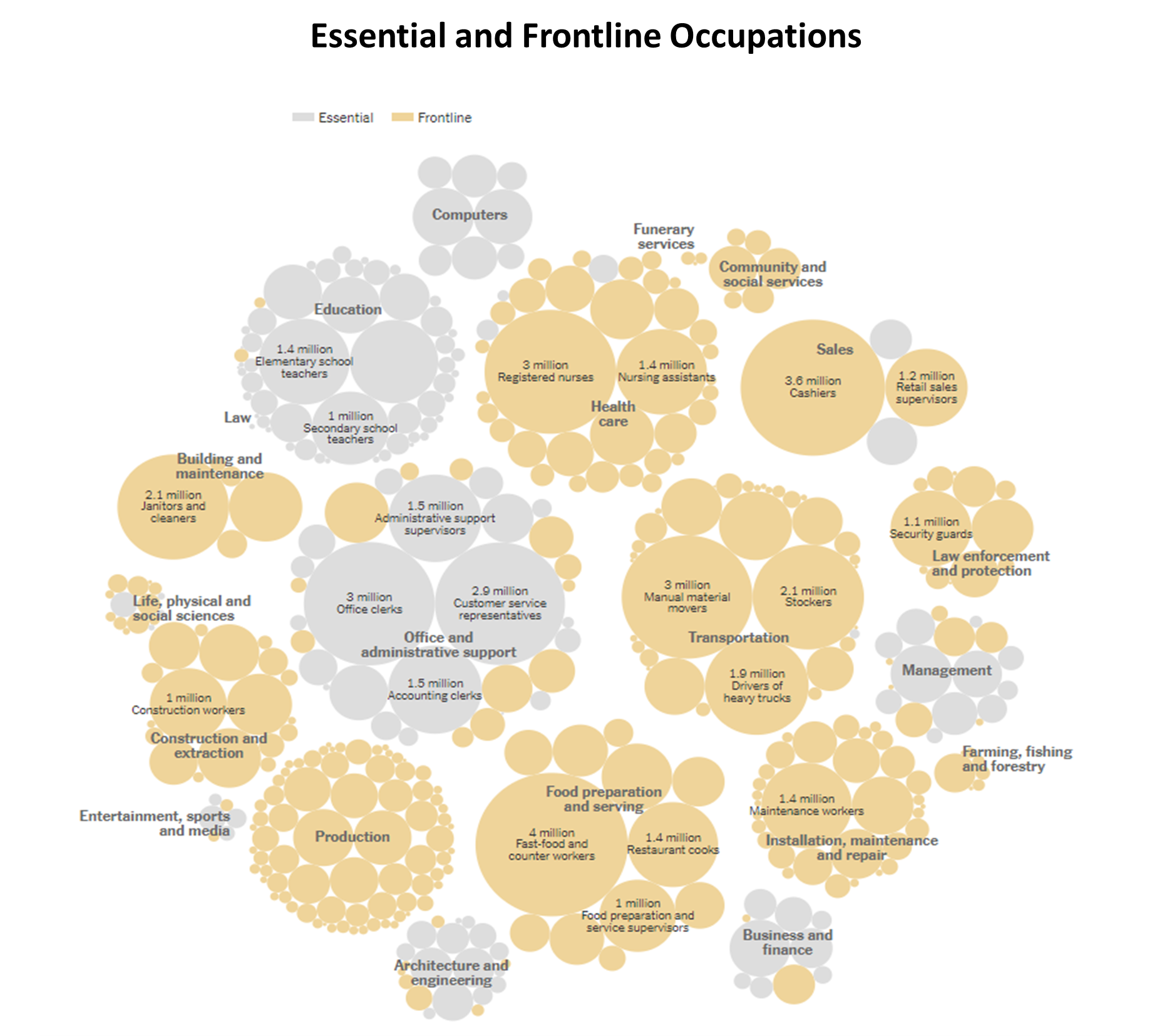
    Who Should Get the Coronavirus Vaccine First? (New York Times). With initial coronavirus vaccine supplies limited, the United States faces a hard choice: Should the country’s immunization program focus in the early months on the elderly and people with serious medical conditions, who are dying of the virus at the highest rates, or on essential workers, an expansive category encompassing Americans who have borne the greatest risk of infection? There are about 90 million essential workers nationwide. A subset are considered “frontline” workers, meaning their jobs cannot be performed from home. Because there will not be enough doses to reach everyone at first, states are preparing to make tough decisions: Louisiana’s preliminary plan, for example, puts prison guards and food processing workers ahead of teachers and grocery employees. Nevada’s prioritizes education and public transit workers over those in retail and food processing.


    * New SEDE Data Available *

    State Economic Development Organization Structures Profiles

    SEDE network members have expressed interest in learning about how other states organize and operate their economic development efforts. In response, CREC has developed a resource designed to help states benchmark and provide a one-stop resource to explore alternative structures for executing state economic development functions. CREC collected publicly available information about 21 economic development organizations in 15 states including: agency mission, organization structure and leadership, budget (sources of funding and how funds are disbursed across functions within the agency), numbers of employees by function, outcomes, and agency accountability. These profiles are now available on the SEDE website behind the firewall. Thanks to the many state leaders who contributed to this work. If you would like further information on this project, please contact Mark Troppe at mtroppe@crec.net.


    Twelve Days of Christmas Price Index Affected by Pandemic (PNC Wealth Management). For the 37th year, PNC Wealth Management has released its Christmas Price Index, a whimsical look at the cost of the gifts in the classic Holiday song, “The Twelve Days of Christmas”. This year, the index accounts for the impact of the pandemic when calculating the cost of the presents. For example, social distancing does not allow for performances such as the drummers drumming or ladies dancing. True Love who purchases the song’s gifts can get by with spending $16,168.14 in 2020 – a 53% decrease over last year due to the pandemic. With the exceptions of the recession in 2000 – 2001 and the pandemic of 2020, prices have been steadily climbing since 1995.


    State Economic Performance

    State Leisure and Hospitality Employment (Bureau of Labor Statistics). From October 2019 to October 2020, Idaho was the only state with an increase in leisure and hospitality employment (0.5 percent). All other states saw declines. Leisure and hospitality included accommodation, food services, arts, entertainment, and recreation-related jobs. Hawaii employment in leisure and hospitality decreased 49.6 percent. Other states with at least a 30-percent decrease in leisure and hospitality employment were New York (−35.0 percent), Massachusetts (−34.9 percent), Vermont (−33.7 percent), and Michigan (−32.1 percent). Leisure and hospitality jobs in the District of Columbia also decreased 35.9 percent over that period. These data are from the BLS Current Employment Statistics (State and Metro Area) program and are seasonally adjusted.


    * Economic Outlook *

    U.S. Presidential Election & Implications on Trade Policy

    President-elect Joe Biden’s economic team is taking shape with plans to remake the Trump administration’s approach to economic relations overseas, with a distinction: agreement with President Trump’s assertion that globalization has been hard on many Americans but differences on how to address it. The World Trade Center St. Louis held a virtual bipartisan panel discussion on the U.S. Presidential election and its implications on trade policy. The panel included Jordan Bernstein of Cassidy & Associates, Kenny Hulshof of Kit Bond Strategies and Robert Shapiro of Thompson Coburn. The session examined how the election outcome affects Free Trade Agreements, tariffs, exports, imports, reshoring, compliance and more. For additional insights on shifting trade tides, check out Biden’s Economic Team Charts a New Course for Globalization, With Trumpian Undertones, click here.

    * * *


    Topics and Trends

    Industry Watch

    Ten Trends to Watch in 2021 (The Economist). The coming year promises to be especially unpredictable, given the interactions between the pandemic, an uneven economic recovery, and fractious geopolitics. As 2021 approaches, The Economist has released its annual World in 2021 publication. Here are ten trends to watch in the year ahead.

    Trade/Tariffs

    U.K. to Drop Tariffs on U.S. Goods in Airbus-Boeing Dispute (Bloomberg). The U.K. government said it will drop the tariffs that the EU had imposed on $4 billion of U.S. goods, part of the long-running dispute over illegal aid to aircraft manufacturers Boeing Co. and Airbus SE. The move is designed to reduce trade tensions with the U.S. and show that the U.K. is serious about reaching a negotiated outcome. Britain will set its own tariff policy when it completes its split from the EU at year-end. The move comes amid broader questions over how much power the U.K. retains post-Brexit to legally impose tariffs in cases that pre-date its exit from the EU. In the case of the Airbus-Boeing dispute, the U.K. insists it has kept that power. The EU announced the tariffs, which target various Boeing models and products including spirits, nuts, and tractors, in November as part of a tit-for-tat escalation against the U.S. — which itself imposed levies on $7.5 billion of EU products in 2019. British exports ranging from Scotch whisky to biscuits to clotted cream have suffered from the duties.

    Opportunity Zones

    Do OZ Investments Make Sense During Covid-19 Crisis?  (Forbes). There are several businesses that are good fits within the Opportunity Zone program because they require significant investment capital relative to the purchase price of land or buildings, as well as having most deal returns generated upon disposition. If the sale of the investment occurs at least 10 years after the purchase, the investor will enjoy the QOZ tax benefits on the sale-generated gains. Expect to see developments of brownfields, energy infrastructure projects (both traditional and alternative energy), and data centers as QOZ businesses. They are usually geographically flexible, and there may be numerous QOZ sites that fulfill the product criteria. Certain corporate expansion efforts — clinics and banking for example — and new or expanding businesses with expensive mobile assets like trucks, airplanes, construction equipment or even semi-permanent solar power storage units might keep those assets in QOZs to enjoy QOZ tax benefits. Finally, QOZ lends itself to impact investing, where there is a financial investment in a business that provides a financial return and a social return. To view the Final Regulations on Opportunity Zones issued by the U.S. Treasury Department and IRS, click here.

    Colorado Receives Opportunity Zone Housing Investment (Business Wire). Arctaris Impact Investors, LLC announced two Opportunity Zone investments to provide workforce housing for low-income communities in rural Colorado. Total development cost is estimated at $60 million for these projects, which include a 100-unit workforce housing project in Glenwood Springs, a 96-unit workforce housing project in Grand Junction and a 74-unit glamping campsite also in Grand Junction. The properties address an immediate need for accessible workforce housing as workers in hospitality, healthcare and trades are getting priced out of the area as more affluent populations move to the region. Arctaris is investing in these projects alongside Four Points Funding, a private real estate investment firm, based in Steamboat Springs and Denver, that manages a series of Opportunity Zone Funds composed of multi-family housing and outdoor-focused hospitality projects. Four Points Funding invests exclusively in Colorado with a focus on smaller and emerging rural communities. For more information on Opportunity Zones, CDFA has extensive resources available, click here.

    The Opportunity Zones program provides a tax incentive for investors to re-invest their unrealized capital gains into Opportunity Funds that are dedicated to investing into Opportunity Zones designated by the chief executives of every U.S. state and territory. Treasury has certified more than 8,700 census tracts as Qualified Opportunity Zones (QOZs) across all states, territories, and the District of Columbia. For a map of all designated QOZs, click here.

    Inclusive Growth

    Recovery and Resilience in Rural America (Brookings). As the COVID-19 pandemic tests the resilience of rural economies in real time, attention should not be focused on an outdated, inaccurate image of rural America, but rather on understanding, sustaining, and investing in the hyperlocal strategies already working to bring growth and equity to increasingly diverse and dynamic rural areas. Using in-depth, on-the-ground research in three rural communities—Wheeling WV, Laramie WY, Emporia KS—the findings highlight key place-based strategies as well as the policy and capacity-building supports needed to sustain and scale them in the years to come. Among the strategies: Main Streets are a key driver of equitable economic recovery in rural America; rural small businesses need local solutions to survive; rural resilience needs a flexible, accessible, and healthy built environment; economic revival requires bridging social divides; and a shared vision of rural resilience comes through community-led civic structures. For additional insights on building resilient rural places, check out Aspen Institute’s Equitable Recovery and Resilience in Rural America, click here.

    Innovation

    Healthtech in the Fast Lane (McKinsey & Company). Digital technology has enabled healthcare players to provide more targeted and effective interventions to patients worldwide. As the COVID-19 crisis continues to shape the next normal, it is crucial that stakeholders in the healthcare industry understand the digital health landscape. Broadly, digital health can be defined as the application of digital technology to improve health or care delivery. The first half of 2020 has seen unprecedented digital health activity: record levels of venture funding of $5.4 billion; megadeals, such as Teladoc Health’s $18.5 billion acquisition of Livongo; and accelerated virtual care delivery, such as telehealth and remote monitoring. As adoption of healthcare technology accelerates, it is a good time for healthcare companies to consider investing in digital among nine potential “value pools.”

    Infrastructure

    Strategies to Expand Affordable Broadband Access (National Governors Association). According to the FCC, at least 18.3 million people, or 6 percent of the total U.S. population, lacked access to fixed broadband that meets minimum internet speeds of 25 megabits per second (Mbps) download and 3 Mbps upload, referred to as “25/3” service. Of those people, 14 million live in rural areas and 1 million live on Tribal lands, which amounts to 22 percent and 28 percent of those respective geographic populations. Recognizing the multiple benefits of broadband connectivity, states are implementing a range of policies and programmatic solutions to expand access and increase affordability. While many of these efforts focus on expanding wired infrastructure, more internet-enabled mobile devices, along with the difficulty of expanding fiber in many rural regions, has made wireless technologies a viable alternative. However, for the highest speeds and most reliable connection, fiber remains the gold standard. The COVID-19 pandemic has created a new urgency for these expansion efforts and, as a result, states are increasingly implementing nearer-term solutions to bridge coverage gaps and provide affordable access to those who lack it.


    Deal Makers

    Incentives in Action

    * SEDE Incentives Compliance Training Held *

    Nevada’s Approach to Incentive Compliance

    SEDE sponsored a training workshop in November 2020 to provide state agency staff with the skills and insights to implement best practices in incentives monitoring and management. The workshop reviewed common operating procedures, identified critical issues, and explored options and tradeoffs to help staff make intentional choices to protect taxpayer investments in business incentives. The training included expert interviews, with insights from Melanie Sheldon, Director of Business Development at the Nevada Governor’s Office of Economic Development, above.

    Hawaii Launches Remote Work Program (Motley Fool). Hawaii needs bodies to stimulate its economy, so it is establishing what it calls a “Movers and Shakas” program that will offer free round-trip tickets to Oahu for out-of-state remote workers who are willing to live in the state for at least 30 consecutive days. Given the number of people who no longer need to report to a physical office building, setting up shop in Hawaii may be an appealing notion. But participants cannot expect to just do their regular jobs and then spend their remaining time lounging on the beach. Those granted those free tickets must commit to helping the state’s economy — specifically, by donating a few hours every week to a nonprofit where they can put their skills to good use. Another anticipated outcome from the program is to boost the state’s vacation rental industry. In 2019, about 30,000 people arrived in Hawaii every day, and that number inched toward 40,000 during the summer travel season. But since the pandemic began, daily arrivals have dipped below 500, which is hurting the state’s economy in a very meaningful way.

    Rhode Island Approves Incentives for Portsmouth Innovation Center (Providence RI Journal). The Rhode Island Commerce Corporation unanimously approved $1.5 million in state incentives for 401 Tech Bridge, a proposed advanced materials and technology center in a renovated building in Portsmouth. The goal of an Innovation Center is to connect partners and turn new technologies into products, businesses, and jobs. The 401 Tech Bridge project has already attracted manufacturers, entrepreneurs, academics, and researchers who hope to build on the state’s strengths in textiles, advanced materials, marine products, and undersea devices developed by the Navy. The $1.5 million in approved incentives includes $1 million in Rebuild Rhode Island tax credits that will be available after the building is completed and $500,000 in First Wave closing funds for the building’s financing. The renovation of the building in Portsmouth should start early next year with an opening in the second half of 2021. The $1.5 million in state incentives is on top of $6.8 million previously received from state and federal sources and nonprofit groups.

    New Growth Opportunities

    Wyoming Making Big Bet on Digital Currency (Tech Transfer Central). Wyoming approved the country’s first special purpose depository institution (SPDI), which is designed to handle digital currencies, in Fall 2020. Two SPDI applications have since been approved. State leaders hailed the new banking institutions, which allow those using digital assets, like cryptocurrency, to access reliable financial services, protect consumers and allow businesses a way to hold digital assets safely. Digital currencies are intangible and can only be owned and transacted by using computers or electronic wallets connected to the Internet or designated networks. Various forms of “cyber cash” are gaining rapidly as a technology driving change in banking and supply chain management, among other fields. The state passed legislation in 2019 which aimed to create a regulatory environment to foster blockchain application growth and diversify the state’s economy. Most recently, the University of Wyoming launched a new Center for Blockchain and Digital Innovation. The center is an interdisciplinary entity with connections to UW’s colleges of Business, Engineering and Applied Science, Agriculture and Natural Resources, and Law. The new center will focus on fostering innovation; applied research and education; technology development; economic development and job growth; and corporate engagement.

    Talent Development/Attraction

    Advancing Workforce Equity in the U.S. (PolicyLink-USC Equity Research Institute). The face of the nation is changing—and with it, the demographics of the workforce. In about 25 years, the United States will no longer have a single majority racial/ethnic group. White people comprise 62 percent of the U.S. workforce overall, but 75 percent of those ages 55 or older. As baby boomers retire, they are being replaced by a much more diverse generation of workers: in 2018, for the first time, people of color accounted for more than half of all new hires of prime working age. As people of color become much of the U.S. workforce, racial inequities in the labor market represent a rising liability for the economy. For instance, racial gaps in the share of workers earning at least $15/hour have been persistent over the past several decades. Among the report’s recommendations: make racial equity a priority and develop systems to track progress; develop targeted strategies to connect people of color to quality employment opportunities; and invest in innovative training and credentialing models.

    Occupational Licensing: Assessing State Policies and Practices (National Conference of State Legislatures). Occupational licensing comprises nearly 25% of the U.S. workforce, up from 5% nearly 60 years ago. The increase in occupations that require government permission to work, while meant to protect consumer health and safety, has also created many discrepancies in requirements across state lines and barriers to work for certain population groups. More than 3,500 occupational licensing bills have been introduced across the country since 2017. Of these, 176 bills sought to ease barriers for people with a criminal record, while 120 bills focused on military veterans and spouses. The findings are part of a new report aimed at providing state policy options and examples on occupational licensing. In addition, the National Conference of State Legislatures (NCSL), in partnership with The Council of State Governments (CSG) and the National Governors Association (NGA Center) for Best Practices, has produced numerous resources. These resources are designed to help state policymakers better understand the variances in licensing laws and the challenges they present for many workers.


    * * *

    SEDE Network Updates

    * Wishing the SEDE Network Happy Holidays *

    &

    State Economic Development Success for 2021!

    * * *

    The SEDE Network Steering Committee includes: Stefan Pryor (RI), Chair; Val Hale (UT), Vice Chair; Julie Anderson (AK); Mike Preston (AR); Sandra Watson (AZ); Kurt Foreman (DE); Don Pierson (LA); Kelly Schulz (MD); Kevin McKinnon (MN); Chris Chung (NC); Alicia Keyes (NM); Michael Brown (NV); Andrew Deye (OH); Dennis Davin (PA); Manuel Laboy Rivera (PR); Jennifer Fletcher (SC); Adriana Cruz (TX); Joan Goldstein (VT); Mike Graney (WV).

    For further questions on the content in this Bulletin or for information on the SEDE Network contact Marty Romitti, CREC Senior Vice President, at mromitti@crec.net

  • State Economic Development Bulletin – November 2020

    State Economic Development Bulletin – November 2020

    Latest News

    The Future of Commercial Office Space (Cushman & Wakefield). Concerns exist about the future of commercial office space. There is no denying that the work from home trend is real and the impacts will be felt in the short and long term. A report from Cushman & Wakefield examining the global impacts of the pandemic on commercial real estate predicts office leasing will be significantly affected for many years with increasing vacancies and decreasing rents in many parts of the world. The highest level of vacancies will occur in the U.S., Canada, and European countries at a net negative level of over 200 million square feet. Even prior to the pandemic, businesses were reducing their footprint in the west, but the significant job losses and work from home (WFH) trend has and will hit the leasing market hard for quite some time. A net 215 million square feet of office vacancy will have been lost due to the pandemic. Global office vacancy will rise from 10.9% pre-COVID to 15.6% by Q2 2022. Office leasing is expected to remain below pre-COVID levels until 2025.


    CIOs Accelerating Digital Transformation for Future of Work (CIO). Work from home is now more than a six-month-old norm for organizations across the globe. The pandemic led CIOs and IT teams across industries—irrespective of sizes—to adopt the new style of work and quickly shift their teams to virtual environments. This transformation required investment in PCs, services, and infrastructure to support the data and work happening. After the initial shift to facilitate remote working, businesses are now shifting from doing it ‘light’ to ‘right’ – where productivity, collaboration, and security have become the key pillars of the connected workforce experience. Post COVID-19, remote working is expected to increase by 20% across all sectors irrespective of sizes which will lead to increasing demand for more IT infrastructure around 5G, AI, and processing power.


    State Economic Performance

    BLS Measures State Productivity (Bureau of Labor Statistics). Labor productivity is measured as the difference between the percentage growth in output and the percentage growth in hours worked. From 2007 to 2019, national productivity increased at an average annual rate of 1.2 percent. The Bureau of Labor Statistics (BLS) now publishes state-level labor productivity and cost measures for the private nonfarm sector, including output per hour, output, hours, unit labor costs, hourly compensation, and real hourly compensation. By analyzing state-level labor productivity measures, data users can learn more about regional business cycles, the persistence of regional income inequality, and which states are driving national productivity trends. Based on the BLS measure, North Dakota, California, and Washington are among the states contributing the most to national labor productivity growth.


    * Economic Outlook *

    We’re Recovering to a Different Economy

    The Covid-19 pandemic brought the economy to a screeching halt, and while it has started its road to recovery, the economy we knew is probably a thing of the past, said Federal Reserve Chairman Jerome Powell at the European Central Bank’s Forum on Central Banking on November 12, 2020. The pandemic has accelerated existing trends in the economy and society, including the increasing use of technology, telework and automation. This will have lasting effects on how people live and work. Even after the unemployment rate goes down and with a vaccine, there is a substantial group of workers who are going to need support finding their way in the post-pandemic economy. Lower-paid workers, as well as those in jobs requiring face-to-face interactions, such as retail or restaurant workers, will shoulder most of the burden of this shift. These groups are heavily skewed towards women and minorities.

    * * *


    Topics and Trends

    Industry Watch

    States and Cities with Most Manufacturing Jobs (Smartest Dollar). Indiana, Wisconsin, Iowa, Michigan, and Alabama have the largest percentages of their employment in manufacturing. At over twice the national average, the Grand Rapids metro area has the largest share of manufacturing employment among cities. However, manufacturing employment in the U.S. has been on the decline for decades. According to data from the U.S. Bureau of Labor Statistics, manufacturing accounted for more than 13 percent of the U.S. nonfarm workforce in 1999, or 17.3 million jobs. Today, just 8.5 percent of workers were employed in the manufacturing sector, totaling less than 13 million jobs. While manufacturing jobs have declined, manufacturing output—measured as the value of goods and services produced—has steadily increased. In fact, labor productivity for U.S. manufacturing is 2.5 times greater than in past decades due to advances in machinery, increased worker skill, and improved industrial processes.


    Trade/Tariffs

    Asia-Pacific Signs World’s Biggest Trade Deal (NPR). Fifteen Asia-Pacific economies signed on to what could become the world’s largest free trade agreement, covering nearly a third of the global population and about 30% of its global gross domestic product. The Regional Comprehensive Economic Partnership (RCEP), backed by China and also including Japan, South Korea, Australia, New Zealand and the 10 Southeast Asian nations, will progressively lower tariffs and aims to counter protectionism, boost investment, and allow freer movement of goods within the region. RCEP was signed in November at the four-day ASEAN summit in Hanoi. However, critics note the deal lacks provisions for protecting workers and the environment and will hurt smallholder farmers and businesses at a time when they are already suffering from the pandemic. Last year, India pulled out of RCEP, citing differences over tariffs and other barriers, and after protests by farmers who feared a flood of cheaper imports from countries such as China, Australia, and New Zealand.

    Opportunity Zones

    The 2020 Year in Review for Opportunity Zones (Motley Fool). Opportunity zones have been one of the most bipartisan pieces of legislation to pass the U.S. Congress in recent years. But as with much of 2020, the arrival of a global pandemic changed many investment plans. Hotel and office projects began to lose their appeal, and funds began to look outside big cities to other markets. President-elect Joe Biden has said he will reform the Opportunity Zone Program. His plan includes incentivizing funds to partner with local organizations to create a community benefit program for each investment. He also wants the Department of Treasury to ensure opportunity zone tax benefits are only allowed when there are clear benefits to the community. The bipartisan Improving and Reinstating the Monitoring, Prevention, Accountability, Certification, and Transparency Provisions of Opportunity Zones (IMPACT) Act emphasizes community benefits. There are also several pieces of legislation before the House and Senate that address how opportunity zones funds handle reporting. The Opportunity Zone Accountability and Transparency Act (H.R. 5011) and the Opportunity Zone Reporting and Reform Act (S. 2787) both look at how projects are tracked. To view the Final Regulations on Opportunity Zones issued by the U.S. Treasury Department and IRS, click here.

    Home Prices Up but Rising Slower in Opportunity Zones (Attom Data Solutions). Housing markets in Opportunity Zones continue improving, even with the Coronavirus pandemic spread. Median home prices increased in 74 percent of opportunity zones year over year, according to Attom’s third quarter 2020 report. Home prices rose by more than 10 percent in over half of the zones. However, the gains still fell below the pace for other areas in the U.S., where about 75 percent saw prices increase by more than 10 percent year over year. The differences potentially reflect the pandemic generally hit hardest in lower-income communities that include most of the zones targeted for tax breaks designed to spur redevelopment. States with the largest percentage of zones that had annual median price increases during the third quarter of 2020 included Washington (median prices up in 88 percent of zones), Missouri (88 percent), Arizona (86 percent), Ohio (83 percent) and Rhode Island (82 percent). For more information on Opportunity Zones, CDFA has extensive resources available, click here.

    The Opportunity Zones program provides a tax incentive for investors to re-invest their unrealized capital gains into Opportunity Funds that are dedicated to investing into Opportunity Zones designated by the chief executives of every U.S. state and territory. Treasury has certified more than 8,700 census tracts as Qualified Opportunity Zones (QOZs) across all states, territories, and the District of Columbia. For a map of all designated QOZs, click here.

    Inclusive Growth

    More Americans Now Live in Prosperous Areas (Economic Innovation Group). The Distressed Communities Index (DCI) sorts U.S. communities based on seven economic indicators and five categories of well-being: prosperous, comfortable, mid-tier, at risk, and distressed. A plurality of Americans (82.4 million) lives in prosperous zip codes and the share of the U.S. population residing in economically distressed zip codes fell from 18 percent in 2000 to 16 percent in 2018. Prosperous zip codes also gained 8.7 million jobs between 2000 and 2018, generating nearly 62 percent of total U.S. job growth over the period. Meanwhile, zip codes that were distressed lost jobs. New Hampshire leads the nation with 47.5 percent of its population living in prosperous zip codes and just 4.1 percent in distressed. California had the largest number of people living in prosperous zips, 10 million. High population states and communities in the Northwest have experienced the greatest increase in standing since 2000.

    Innovation

    Demand for Sustainable Aviation Fuel Drives Innovation (Research and Markets). Stringent regulations regarding sustainable aviation fuel (SAF) is boosting the competition among aviation fuel manufacturers which is also positively impacting the overall growth of the global aviation fuel market. Various biofuels that can significantly reduce carbon emissions for aircraft offers lucrative opportunities for the growth of the aviation fuel industry. United Airlines was the first U.S. airline to begin the use of SAF for regularly scheduled flights. In 2019, Boeing announced that the company will be offering airlines and operators the option of powering their new commercial jet with biofuel for return flights. The company’s initiative aims to drive down emissions by up to 80 percent and protect the environment. Many governments are also focusing on the use of sustainable aviation fuel for military aircraft which will also drive overall market growth.

    Infrastructure

    The Growing Role of Energy Storage (National Conference of State Legislatures). States have been ramping up clean energy generation. Much of this growth has been driven by state initiatives, such as financial incentives and renewable portfolio standards, coupled with the declining costs of renewable energy technologies. Many states see clean energy generation as the key to decarbonizing both the transportation and power sectors, together responsible for 55% of greenhouse gas emissions in the U.S. – and as an economic development opportunity. With these efforts, energy storage technologies have emerged as a critical infrastructure component to maximize the benefits of clean energy technologies. There are several types of energy storage technologies in use today, with pumped-hydro (94% of storage total) providing the most storage capacity and battery storage (6% of total) being the fastest-growing. The U.S. is among the leaders in developing and deploying energy storage infrastructure, with 40 percent of the 1,366 “renewable plus storage” projects either operational or under construction globally. For the most recent U.S. Grid Energy Storage Factsheet, click here.


    Deal Makers

    Incentives in Action

    * SEDE Incentives Series Report *

    A New Approach to the But-For Question

    Assessing the importance of incentives in influencing corporate investments is fraught with uncertainty. Since incentives are just one factor among many influencing investment decisions, there are good reasons to re-think how we have come to use the term “but for” when we talk about incentives. This paper suggests that, instead of an all-or-nothing binary approach, the effect of incentives on investment decisions should be considered as a probability between 0 and 100% and offers a methodology for estimation.

    Nevada Knowledge Fund Project Promotes SBIR Success (Nevada GOED). With Knowledge Fund support, the Nevada Governor’s Office of Economic Development (GOED) has expanded a University of Nevada, Reno (UNR) program which helps technology entrepreneurs earn federal SBIR and STTR grant funding to southern Nevada at the University of Nevada, Las Vegas (UNLV). The Knowledge Fund, administered by GOED, supports projects at UNLV, UNR, and the Desert Research Institute (DRI) that advance industry innovation in the state. The cornerstones of UNR’s Sierra Accelerator for Growth and Entrepreneurship (SAGE) program are mentorship and technical support. SAGE begins by helping determine if an idea or business qualifies for the SBIR and STTR programs. It then helps participants determine the right agency to apply to, map a strategy, write the best possible proposal, and navigate the federal grant submission system. GOED wants to expand the reach of the successful SAGE North program to create a statewide SBIR/STTR support structure for small business innovation.

    Arizona Trains Students for Cloud Careers (Arizona ACA). The Arizona Commerce Authority (ACA) with the support of Amazon Web Services, Inc. (AWS) announced a statewide initiative to increase access to cloud computing education in schools across Arizona. This initiative aims to train and certify 5,000 students for entry-level cloud computing careers by June 2022. Job postings data revealed a significant skills gap in Arizona for positions requiring cloud computing skills, with many of the jobs specifically seeking AWS skills. The ACA will work with Arizona secondary and post-secondary schools to enable the AWS Academy and AWS Educate programs to integrate cloud computing education into classrooms using content mapped to in-demand technical careers. AWS Academy provides no-cost, ready-to-teach, cloud computing curriculum that prepares students for industry-recognized AWS Certifications, including AWS Certified Cloud Practitioner, AWS Certified Solution Architect – Associate, and AWS Certified Developer – Associate.

    New Growth Opportunities

    The Future of Food: Meatless? (McKinsey & Company). Plant-based “meat” is all the rage. Companies big and small are investing in alternative proteins, expecting continued strong growth. History has shown that people are willing to shift their diet. Forty years ago, we ate 90 pounds of beef per person; now we eat 60. Chicken consumption has increased from 40 to 90 pounds. Impossible Foods, headquartered in Silicon Valley, is a leader in developing alternative protein products. CFO David Lee notes: The company’s Impossible burger was never designed to compete with the health benefits of broccoli. It was designed to compete in the $1.7 trillion global meat and dairy market in which meat eaters want to eat meat not just every week but at every meal. With the Impossible burger consumers are forgoing the cholesterol with 10 to 20 percent fewer calories. Innovation will continue to power the alternative protein market. Anything the meat eater can imagine will eventually be launched. Impossible Foods, for example, creates 100 prototypes a week, such as plant-based pork, chicken noodle soup, and fish risotto. It also has platforms to develop whole cut products — steak, chicken breast, whole fish filets.

    Talent Development/Attraction

    National Apprenticeship Week Held (U.S. Department of Labor). National Apprenticeship Week was held November 8-14, 2020 as a nationwide celebration that brings together business leaders, career seekers, labor, educational institutions, and other critical partners to demonstrate their support for apprenticeship programs. It also provides apprenticeship sponsors with the opportunity to showcase their programs, facilities, and apprentices in their community. There are five key components that differentiate apprenticeships from other types of workplace training programs. These include pay, both work-based and classroom learning, mentorship, and earning credentials. Apprenticeship.gov maintained by the U.S. Department of Labor is a one-stop resource to connect career seekers, employers, and education partners with apprenticeship information and opportunities.


    Employment, Earnings, and Occupations of Post-9/11 Veterans (U.S. Census Bureau). As the most recent and youngest veteran cohort, Post-9/11 veterans represent a large and growing segment of the veteran population. A new report from Census shows this group of veterans are more likely to be employed and earn more than nonveterans. Using American Community Survey (ACS) data, the study shows the median earnings for a Post-9/11 veteran is nearly $11,000 more per year than a nonveteran ($46,000 compared with $35,000). These veterans were more likely to work in protective services; installation, maintenance, and repair; transportation; computer and mathematical; architecture and engineering; and business and financial operations occupations.


    * * *

    SEDE Network Updates

    * Check out the SEDE Website *

    StateEconomicDevelopment.org

    The SEDE Network engages in regular activities and events throughout the year. You can stay up to date on all these activities via the SEDE Network website. The site includes a collection of websites and other resources used by states to address the Coronavirus Challenge.

    Click the link above and check it out!

    * * *

    The SEDE Network Steering Committee includes: Stefan Pryor (RI), Chair; Val Hale (UT), Vice Chair; Julie Anderson (AK); Mike Preston (AR); Sandra Watson (AZ); Kurt Foreman (DE); Don Pierson (LA); Kelly Schulz (MD); Kevin McKinnon (MN); Chris Chung (NC); Alicia Keyes (NM); Michael Brown (NV); Andrew Deye (OH); Dennis Davin (PA); Manuel Laboy Rivera (PR); Jennifer Fletcher (SC); Adriana Cruz (TX); Joan Goldstein (VT); Mike Graney (WV).

    For further questions on the content in this Bulletin or for information on the SEDE Network contact Marty Romitti, CREC Senior Vice President, at mromitti@crec.net

  • State Economic Development Bulletin – October 2020

    State Economic Development Bulletin – October 2020

    Latest News

    U.S. Census Provides Monthly State Retail Sales Data (U.S. Census Bureau). The U.S. Census is launching a new experimental data product featuring modeled state-level retail sales. The Monthly State Retail Sales (MSRS) report features interactive state-level data visualizations that combine data from the Monthly Retail Trade Survey, administrative data, and third-party data. The first month’s data covers June 2020, and it will continue to be published monthly on an ongoing basis. Within the report, year-over-year percent changes are available for total retail sales excluding non-store retailers as well as for 11 North American Industry Classification System (NAICS) retail subsectors.


    Shocking Number of Women Out of Workforce (CNN Business). Hundreds of thousands of women -nearly eight times more than the number of men – dropped out of the U.S. labor force last month. About 617,000 women left the workforce in September, compared with only 78,000 men, with half of the women who dropped out being in the prime working age of 35-44. Women have been hit harder by this recession than in previous downturns. Industries that employ lots of women, such as hospitality and leisure, are faring worse during the pandemic. Women are also more likely to take on the care responsibilities in the home, which during a time of homeschooling and home caring can make it hard for many to continue their professional careers. Last month’s massive workforce dropout rate for women is at least partially due to the lack of childcare options, with child daycare services employment still down nearly 18% in September from its pre-pandemic level. Until parents have adequate care options for their children again, many women will not be able to return to work.


    * Upcoming SEDE Training Opportunity *

    Designing and Managing Business Incentive Compliance Efforts

    November 9, 10, 16, 17, 2020

    2:00 PM – 4:30 PM ET

    Consult the SEDE Network Updates section at the end of this month’s Bulletin for more details or click on the link above and check it out!


    State Economic Performance

    Worker Tenure with Current Employers Stable at 4.1 years (Bureau of Labor Statistics). The median number of years that wage and salary workers had been with their current employer was 4.1 years in January 2020, little changed from 4.2 years in January 2018. Median tenure is the point at which half of all workers had more tenure and half had less tenure. Employee tenure was generally higher among older workers than younger ones. For example, the median tenure of workers aged 55 to 64 (9.9 years) was more than three times that of workers aged 25 to 34 (2.8 years). The share of wage and salary workers with a year or less of tenure with their current employer was 22 percent in January 2020, unchanged from January 2018. This short-tenured group includes new hires, job losers who found new jobs, and workers who had voluntarily changed employers during the year.

    * Economic Outlook *

    Slowing Recovery Needs More Support

    Although the economic recovery “has progressed more quickly than generally expected … the outlook remains highly uncertain,” said Federal Reserve Bank Chairman Jerome Powell, in a speech to the National Association for Business Economics. The U.S. economy is clearly not out of the woods and needs more policy intervention by monetary and fiscal authorities rather than less, according to Powell. The pace of the economic recovery has slowed since May and June, permanent job losses are rising, and the broader unemployment rate, though officially down to 7.9%, is closer to 11% after accounting for job status mischaracterizations and the decline in labor force participation. Powell also notes the widening wealth gap due to the disproportionate impact of the pandemic on communities of color and women. Note: Chairman Powell begins his remarks at the 11:30 minute mark of the video.

    * * *


    Topics and Trends

    Industry Watch

    The Future of Work in Oil, Gas and Chemicals (Deloitte). The global pandemic, which plunged demand for crude and petroleum products such as gasoline and jet fuel, has led to the fastest layoffs in the oil and gas industry’s history. About 107,000 oil, gas, and petrochemical workers – or about 7 percent of the 1.5 million employed in the industry nationally – have been laid off since the pandemic began. Crude prices could remain depressed for years as growing concerns about climate change push countries and companies to shift to renewable energy. In Texas, for instance, drilling and oil-field services companies now employ 162,350 workers, about half of the 297,100 workers at peak employment in December 2014. Even if crude prices rise to $45 per barrel, Deloitte estimates 70 percent of oil and gas jobs lost during the pandemic may not return by the end of 2021. If crude falls to $35 a barrel, 97 percent of jobs may not return by the end of next year. In an optimistic scenario where oil prices jump to pre-pandemic levels of $55 a barrel, a quarter of the jobs lost may not return.

    Trade/Tariffs

    China Extends Tariff Exemptions on 16 U.S. Products (South China Morning Post). China has decided to exempt tariffs on a batch of 16 U.S. products, including fish meal, lubricants, and cancer medications, for another year, marking a small concession in a much broader trade war with the United States. China’s Ministry of Finance said on its website that it extended its 2019 decision to exempt the 16 American products from additional tariffs until September 16, 2021. Those tariffs were levied in 2018 when China was engaging in a tit-for-tat tariff war with the U.S. However, the additional tariffs began to hurt Chinese importers, and Beijing started asking them in May 2019 to apply for exemptions. China’s exemption of additional tariffs on U.S. products is largely technical, as the exemptions are made upon request from importers. However, such exemptions also translate into lower tariffs on U.S. products that can be read as friendly and goodwill signs.

    Opportunity Zones

    Opportunity Zone Rule Change Seeks Foreign Investors (The Real Deal). The Internal Revenue Service is considering new rules pertaining to foreign investors’ ability to defer capital gains in the Opportunity Zones program. Experts predict the changes will be geared toward giving foreign investors more clarity on their tax liabilities. While foreign investors are not excluded from participating in OZ projects, there is some uncertainty over how they would be taxed and whether they could withhold capital gains. The potential rule changes come at a time when some countries are looking to take advantage of low interest rates in the U.S. and invest in commercial real estate. Only individual foreign investors or eligible foreign-owned businesses with capital gains from selling a U.S. business or piece of real estate would qualify. Tax-exempt institutional investors, such as pension funds and endowments, are not eligible. These new regulations could be released in December. To view the Final Regulations on Opportunity Zones issued by the U.S. Treasury Department and IRS, click here.

    New Jersey Launches Consulting Service for Businesses in Opportunity Zones (NJ Business & Industry Association). The New Jersey Economic Development Authority (NJEDA) announced the Business Consulting for COVID-19 Recovery Program, a free consulting program to help small businesses in NJ Opportunity Zones address the challenges they are facing as a result of the COVID-19 pandemic and help them prepare for a strong long-term recovery. The program is open to all businesses with five or fewer employees that maintain a physical storefront or office in one of New Jersey’s 169 Opportunity Zones. Working with the African American Chamber of Commerce of New Jersey and the Statewide Hispanic Chamber of Commerce of New Jersey, the program will offer up to 25 hours of free, one-on-one coaching and support to make businesses more profitable while maintaining compliance with COVID-19 era public health protections. Participating businesses will receive advice and assistance in securing grants and loans, adapting their business models to current needs, crafting long-term business strategies, evaluating their financial health, and improving accounting and bookkeeping systems, as well as other topics that can help them build a stronger, more sustainable business. Currently in the pilot phase, the NJEDA anticipates expanding the program soon to accommodate more businesses. For more information on Opportunity Zones, CDFA has extensive resources available, click here.

    The Opportunity Zones program provides a tax incentive for investors to re-invest their unrealized capital gains into Opportunity Funds that are dedicated to investing into Opportunity Zones designated by the chief executives of every U.S. state and territory. Treasury has certified more than 8,700 census tracts as Qualified Opportunity Zones (QOZs) across all states, territories, and the District of Columbia. For a map of all designated QOZs, click here.

    Inclusive Growth

    How Equity is Leading Communities’ Responses to COVID-19 (Urban Institute). Before the pandemic, the outlook for low-wage workers was beginning to brighten. U.S. Census Bureau poverty data showed that overall household incomes increased while poverty decreased in 2019. The pre-pandemic expectation was that jobs in services would continue to grow as a sector resulting in workers earning more money. COVID-19 reversed progress for low-paid workers. However, cities and states are continuing to push for an inclusive recovery. Washington DC, for example, has stayed the course on increasing the minimum wage while other communities are looking to their existing workforce as assets to help keep businesses and services operating. Health departments in California, Illinois, Massachusetts, and New York are retraining their unemployed workers to become public health workers and contact tracers, with pay ranging from $15 an hour to $65,000 a year. Similarly the Healthcare Career Advancement Program supported by JPMorgan Chase will provide infectious disease preparedness training to workers hired to fill the shortages in health care settings and also provide longer-term digital skills development that these workers can use to advance their career pathways.

    Innovation

    City Clean Energy Scorecard 2020 (American Council for an Energy-Efficient Economy). The ACEEE City Scorecard 2020 shows that local governments took more than 160 new actions—new initiatives or expansions of past ones—to advance their clean energy efforts. The Scorecard compares cities across five policy areas: Local government operations, Community-wide initiatives, Buildings policies, Energy and Water utilities, and Transportation policies. New York City earned the top spot for the first time. New York and St. Louis, for example, became the second and third cities in the nation—after Washington, DC—to establish performance standards for large buildings. Philadelphia passed a tune-up policy that will save energy in the city’s large buildings. Detroit developed its first Sustainable Action Agenda and, in the process, codified goals to reduce greenhouse gas (GHG) emissions, ramp up energy savings and renewable energy use, and mitigate urban heat islands. Los Angeles, Providence, and St. Paul are tackling transportation, having adopted vehicle-miles-traveled reduction targets over the past year. But cities still have a long way to go in tracking the performance of their policies, giving community input a stronger role in shaping actions, and ensuring actions are designed to serve all residents.

    Infrastructure

    Building the Future Infrastructure Workforce (Brookings). From transportation to water to energy, our country’s infrastructure depends on millions of workers every day. Even though these positions tend to pay higher wages, pose lower educational barriers to entry, and have enormous replacement needs, there are struggles to connect prospective workers – especially younger and more diverse workers – to careers in this space. As Congress looks to support small businesses and other affected industries during the COVID-19 recession, there is an opportunity to hire, train, and retain talent in the skilled trades. The Brookings Metropolitan Policy Program hosted an event exploring the potential significance of a new InfraCorps Program. This multiyear federal program aims to develop a diverse workforce in the skilled trades as part of an Infrastructure Stimulus Plan for the COVID-19 Recession.


    * Check out the SEDE Website *

    StateEconomicDevelopment.org

    The SEDE Network engages in regular activities and events throughout the year. You can stay up to date on all these activities via the SEDE Network website. The newest addition to the site includes a collection of websites and other communication resources used by states to address the Coronavirus Challenge.

    Click the link above and check it out!


    Deal Makers

    Incentives in Action

    Michigan Adapting Incentives to Help Distressed Communities (Smart Incentives). States face a constant struggle to encourage an even distribution of new investment activity. Incentive program managers often feel this challenge most keenly. Many flagship programs include tiered benefits that provide higher incentives for investment in distressed or lagging locations, but regional disparities have become worse in many states. Forward thinking economic development leaders are trying a new approach. They are adapting their incentive program rules and metrics to prioritize investment that benefits distressed places and the people living in those communities. The Michigan Economic Development Corporation, for instance, is focusing more on the impact to people holding the jobs, and not just the company itself. This means asking companies for more detail on the occupations and benefits offered with proposed new jobs and evaluating the average wages by occupation. MEDC is also assessing the proportion of occupations that are considered either good jobs or promising jobs, whether proposed wages get individuals or households over a living wage threshold, and what other actions or services can help projects follow through on the promise of good jobs, like connecting companies with local workforce service and training providers.

    Report Touts Maine’s Historic Properties Tax Credit (Maine Preservation). Maine’s tax credit for restoring historic buildings has generated $525 million in construction investment since it was launched in 2008, according to a recent report. The loss of state tax revenue, estimated at $115 million, has been more than offset by the boost in local property tax revenues, as well as income and sales taxes. The state tax credit has provided financing to help rehabilitate 3.6 million square feet of commercial and residential space and has preserved nearly 2,000 housing units, 1,300 of which are considered affordably priced for middle-income residents. To be eligible for the state tax credit, a structure must pass a review of its historic nature by the Maine Historic Preservation Commission and National Park Service and receive a federal tax credit of up to 20 percent for rehabilitation costs. A building owner or developer can then take a tax credit of up to 25 percent of the cost of restoring a building for reuse. The state credit can be expanded to 34 percent if used for housing. The credit for both categories is limited to $5 million annually for four years.

    GM Owes Ohio $28 Million for Plant Closing (Reuters). General Motors will repay $28 million in state tax incentives to Ohio after the largest U.S. automaker came under heavy criticism for closing its Lordstown Assembly plant in March 2019. The Ohio Tax Credit Authority said the closure violated the terms of two economic development agreements signed by the company, which included failing to retain 3,700 jobs in exchange for the credits. It was ordered to pay back around half of the more than $60 million in tax benefits received, and to provide an additional $12 million in community support programs in the Mahoning Valley, where the plant was located. The funds will be used for education and job training at Youngstown State University and other colleges, community programs and infrastructure projects. GM said in a statement the authority had recognized “GM’s substantial manufacturing presence across the state of Ohio.” For example, GM and LG Chem through the Ultium Cells LLC joint venture, are building a $2.3 billion battery cell manufacturing plant in Lordstown. The state said it awarded a 15-year Job Creation Tax Credit to the joint venture, which is expected to create 1,000 full-time positions.

    The State Business Incentives Database is a national database maintained by the Council for Community and Economic Research (C2ER) with almost 2,000 programs listed and described from all U.S. states and territories. The Database gives economic developers, business development finance professionals, and economic researchers a one-stop resource for searching and comparing state incentive programs. To view the information available in the database, click here.

    New Growth Opportunities

    Reimagining Road Right-of-Ways for Solar (Government Technology). A research report by the University of Texas-Austin identifies more than 127,000 acres of right-of-way areas at interstate exits around the country as suitable for locating solar power generating sites. Solar installations at interstate exits have the potential to generate some 36 terawatts of energy per year – which equals about 1 percent of U.S. electricity consumption. For example, the Oregon Department of Transportation (ODOT) partnered with Portland General Electric (PGE) to produce two solar sites. The first one, a pilot in 2008 on Interstate 5, installed about 600 panels to produce about 104 kilowatts. A second project in 2012 installed 7,000 solar panels to produce 1.75 megawatts. At both sites ODOT provides the land, but the agency does not own, operate, or maintain the solar arrays. Several installations in states like Georgia, Oregon, Maryland, and Massachusetts are also producing power. For a mapping tool showing the location, size, estimated solar energy production, and estimated value of that solar production for interstate interchanges in the lower contiguous 48 states, click here.

    Talent Development/Attraction

    What Global Executives Envision for the Post-Pandemic Workforce (McKinsey Global Institute). Not only has COVID-19 thrown millions out of work, but the mix of jobs that emerges from this crisis is likely different than those that were lost, creating greater demand for workers to fill jobs in areas like health and hygiene, cybersecurity, and data analytics. To understand these changes, McKinsey surveyed business executives around the world. The results suggest that the crisis may accelerate some workforce trends already underway, such as the adoption of automation and digitization, increased demand for contractors and gig workers, and more remote work. Most respondents (85 percent) said their businesses have somewhat or greatly accelerated the implementation of technologies that digitally enable employee interaction and collaboration, such as videoconferencing and filesharing. Roughly half of those surveyed reported increasing digitization of customer channels via ecommerce, mobile apps, or chatbots. Some 35 percent have further digitized their supply chains by connecting their suppliers with digital platforms in supply chain management.

    Manufacturers Should Talk to Employees about Race (Forbes). If you are the boss or a manager in your company, talking to your employees about race, listening to their concerns, and taking steps to address those concerns offer an opportunity to reach across racial and political lines, bridge some of our most troubling divisions, and help solve some of our society’s most persistent, painful problems. If that does not convince you, it is also good for business. A ton of studies have shown that empathetic leaders are better leaders who deliver more profits. Likewise, one of the biggest problems for many manufacturing leaders in the last 15 years has been the difficulty in finding, hiring, and keeping talent. Covid-19 will not change that. When the pandemic subsides, the pool of qualified factory workers will quickly dry up again. Meanwhile, Black Americans could be the country’s single greatest untapped talent pool. They are vastly underemployed—as many as 30 percent of Black adults want to work but have stopped looking or have jobs but would like to work more. Tapping into that industrious, ambitious cohort could solve manufacturers’ talent problems in many parts of the country.


    * * *

    SEDE Network Updates

    * Upcoming SEDE Training Opportunity *

    Designing and Managing Business Incentive Compliance Efforts

    November 9, 10, 16, 17, 2020
    2:00 pm – 4:30 pm EDT

    More Info

    This training workshop provides state agency staff with the skills and insights to implement best practices in incentives monitoring and management. The workshop reviews common operating procedures, identifies critical issues, and explores options and tradeoffs to help staff make intentional choices to protect taxpayer investments in business incentives. Agency staff will be able to review and redesign operating procedures, confident their approach will be effective, but not overly burdensome, in leveraging reliable data for monitoring business compliance and program performance.

    Instructors will provide guidance and best practices to state agency staff in incentives compliance procedures, especially related to:

    • Clarity on the rules for companies using incentives. By and large, companies are willing to comply if they know the rules and they are easy to follow.
    • Public sector data collection, validation, and management procedures
    • Working with the company for successful compliance
    • Dealing with noncompliance
    • Reporting compliance and performance impacts to decision makers

    Target Audience:

    This training program is targeted to state agency economic development professionals assigned to manage or implement compliance procedures. It may also be valuable to local EDO staff or leadership that oversee compliance personnel or activities or want to learn more about the mechanics of business incentive compliance.

    Meet the Instructors:

    Ellen Harpel, President, Business Development Advisors/ Smart Incentives

    Jane Vancil, CEO, Incentilock

    * * *

    The SEDE Network Steering Committee includes: Stefan Pryor (RI), Chair; Val Hale (UT), Vice Chair; Julie Anderson (AK); Mike Preston (AR); Sandra Watson (AZ); Kurt Foreman (DE); Don Pierson (LA); Kelly Schulz (MD); Kevin McKinnon (MN); Chris Chung (NC); Alicia Keyes (NM); Michael Brown (NV); Andrew Deye (OH); Dennis Davin (PA); Manuel Laboy Rivera (PR); Jennifer Fletcher (SC); Adriana Cruz (TX); Joan Goldstein (VT); Mike Graney (WV).

    For further questions on the content in this Bulletin or for information on the SEDE Network contact Marty Romitti, CREC Senior Vice President, at mromitti@crec.net

  • State Economic Development Bulletin – September 2020

    State Economic Development Bulletin – September 2020

    Latest News

    Visualizing Vulnerable Jobs Across America (Brookings). The Brookings Workforce of the Future initiative breaks down the number and dispersion of “vulnerable” jobs for 380 metropolitan statistical areas and all 50 states plus the District of Columbia. Vulnerable jobs are ones that pay low wages (less than the median wage, adjusted for location), and are not covered by employer-sponsored health care benefits. Under this metric, 19 percent of U.S. jobs are vulnerable. Workers in vulnerable jobs face the dual challenge of scraping by on low pay and managing their own health care—an issue thrown into sharp relief by COVID-19. Understanding vulnerability can give states and cities a sense of how exposed their workers are to the COVID-19 crisis in the short term and help them create long-term recovery strategies. The website tool allows users to select a city or state from the drop-down menu for a sector-by-sector breakdown of vulnerable workers in the economy, and to compare with other cities and states.


    Paycheck Protection Program Crucial Lifeline Despite Fraud (The Guardian). Now that the paycheck protection program (PPP) has ended, there is a new story evolving. It seems like millions of dollars meant to prop up small businesses were fraudulently received by a bunch of bad people. The cases are something out of The Wolf of Wall Street. There’s money stolen to pay for Rolls-Royces, luxury yachts, homes, and visits to strip clubs. But despite these very real scandals these government programs worked. Millions of loans were extended to small businesses that really needed them. Billions of dollars were made available – quickly – to keep many companies afloat, or at the very least provide them with a cushion to operate through these very unprecedented times. The fraud – hundreds of millions – sounds like a lot. But as a percentage of the overall program it is not. And let’s hope this doesn’t stop Congress from doing another round of PPP or some other type of stimulus for those businesses that really need it.


    * Upcoming SEDE Training Opportunity *

    Designing and Managing Business Incentive Compliance Efforts

    November 9, 10, 16, 17, 2020

    2:00 PM – 4:30 PM ET

    Consult the SEDE Network Updates section at the end of this month’s Bulletin for more details or click on the link above and check it out!


    State Economic Performance

    Fastest-Growing Industry from 2019 to 2029 is Healthcare and Social Assistance (Bureau of Labor Statistics). Employment is projected to grow from 162.8 million to 168.8 million over the 2019–29 decade, an increase of 6.0 million jobs. This reflects an annual growth rate of 0.4 percent, slower than the 2009–19 annual growth rate of 1.3 percent. Healthcare and social assistance is projected to be the fastest growing industry sector in the economy. Factors that are expected to contribute to the large increase include increased demand from caring for the aging baby-boom population, longer life expectancies, and continued growth in the number of patients with chronic conditions. Manufacturing is projected to lose 444,800 jobs from 2019 to 2029. Factors contributing to the loss of manufacturing jobs include the adoption of new productivity-enhancing technologies, such as robotics and international competition. BLS is developing alternate scenarios for the 2019–29 projection period that encompass possible impacts from the pandemic. An analysis of these scenarios will be released in a Monthly Labor Review article later in 2020.

    * Economic Outlook *

    Household Use of Covid-19 Stimulus Payments

    Under the Coronavirus Aid, Relief, and Economic Security (CARES) Act, American households received stimulus payments of up to $1,200 per adult for individuals whose income was less than $99,000 (or $198,000 for joint filers) and $500 per child under 17 years old or up to $3,400 for a family of four. In a first look at results from consumer spending questions in the federal government’s Household Pulse Survey, a majority of respondents (59 percent) who received a stimulus check used the stimulus payment to mostly pay for expenses, particularly food purchases. For the respondents who experienced a loss of income since March 13, or who were sick or caring for someone else, the stimulus payment helped them meet their expenses. The survey also finds that respondents in Generation X were more likely to use the stimulus for expenses, whereas older respondents, such as those in the Silent generation, were more likely to save the stimulus payment.

    * * *


    Topics and Trends

    Industry Watch

    Five Myths about Manufacturing (Washington Post). The pandemic has brought fresh urgency to the discussion of whether the United States should bring more of its manufacturing back home (particularly for drugs and medical equipment). Yet myths about this sector persist — and they can lead to expensive subsidies, friction between nations, and higher prices for consumers. One hope is that trade wars and the pandemic will bring manufacturing back to the United States. However, there is no evidence of any coronavirus-induced rush by companies to return operations to the United States, and if China tariffs have had an effect, it’s mainly to encourage companies to move plants to places in Southeast Asia, like Vietnam. According to a Fraunhofer Institute study, for every company that reshored production, three offshored factories. Far from retracting their manufacturing presence abroad, U.S. companies are likely to expand it — in part to meet demand from the millions of Asians who are entering the middle class. Companies need factories close to these consumers so they can respond to the desire for ever-faster deliveries. Other manufacturing myths include most new factories are built in low-cost countries; most factories will soon be fully automated; China makes everything now; and 3-D printing will soon change all the rules in manufacturing.

    Trade/Tariffs

    Chinese Chip Giant SMIC ‘In Shock’ after U.S. Trade Ban Threat (BBC News). China’s largest chip manufacturer’s stock sank after the U.S. revealed it could be its next trade ban target. Semiconductor Manufacturing International Corporation (SMIC) said it was “in complete shock and perplexity” after the Pentagon revealed it had proposed the firm be added to a government blacklist. This would restrict suppliers from providing it with American-based tech without special permission. The move against SMIC continues a trade clash that has already threatened Chinese tech firm Huawei’s survival and forced Bytedance to negotiate the sell-off of video-sharing app TikTok’s American operations. SMIC has a less advanced production line than some of its rivals – it cannot make transistors as small as they can, limiting its ability to produce some of the cutting-edge chips featured in the latest smartphones. Even so, the firm is an important semiconductors provider to Chinese companies, including Huawei, while also serving international clients including Qualcomm. Semiconductors and components are ranked as the industry most vulnerable to trade dispute disruptions, according to the McKinsey Global Institute.


    Opportunity Zones

    White House Releases Assessment Report of Opportunity Zones (Council of Economic Advisors). While the COVID-19 pandemic slowed investment everywhere in the second quarter of 2020, including in Opportunity Zones, an initial assessment released by the President’s Council of Economic Advisors (CEA) suggests that the OZ model has the power to mobilize investors; engage state, local, and tribal stakeholders; and improve the outlook for low-income communities—all with limited prescription from the Federal Government. The CEA finds that the OZ tax cuts have spurred a large investment response, including estimates that Qualified Opportunity Funds raised $75 billion in private capital by the end of 2019, most of which would not have entered OZs without the incentive. This new private equity investment in OZ businesses grew 29 percent higher relative to the comparison group of businesses in eligible communities that were not selected as OZs. The growth in investment has also made OZs more attractive to their residents, as reflected in rising home values along with greater amenities and economic opportunity. To view the Final Regulations on Opportunity Zones issued by the U.S. Treasury Department and IRS, click here.

    Potential Legislative Improvements to Opportunity Zones (OpportunityDb). This podcast episode discusses why Opportunity Zones are important and what legislative changes are being considered to improve the impact with Emily Lavery, legislative analyst for Senator Tim Scott (R-SC), one of the original co-sponsors of the OZ legislation. The episode covers when potential legislative changes to OZ reporting might get introduced into Congress, a summary of Senator Scott’s 10-point letter to Treasury and how it resulted in several deadline relief measures for OZ funds and investors, the potential for OZs to be a key component in the push for supply chain re-domestication and manufacturing onshoring, and the need for extending the December 31, 2026 capital gain recognition deadline. It also asks how a potential change in the Presidency may affect the Opportunity Zone incentive. For more information on Opportunity Zones, CDFA has extensive resources available, click here.

    The Opportunity Zones program provides a tax incentive for investors to re-invest their unrealized capital gains into Opportunity Funds that are dedicated to investing into Opportunity Zones designated by the chief executives of every U.S. state and territory. Treasury has certified more than 8,700 census tracts as Qualified Opportunity Zones (QOZs) across all states, territories, and the District of Columbia. For a map of all designated QOZs, click here.

    Inclusive Growth

    Equality in the U.S. Starts with Better Jobs (Harvard Business Review). Even in the pre-Covid world of low unemployment, 32% of the U.S. workforce — 46.5 million people — worked in occupations with a median wage of less than $15 an hour. With Covid-19, we started calling many of these workers “essential.” Yet one wouldn’t know it from their wages. The median wage for a meatpacker is $14 an hour; only $12 for a health aide. Future job growth is also expected largely in low-wage jobs such as health aides, food and cleaning services, and laborer occupations. This problem won’t be solved by upskilling or improving education alone. To address this critical moment, we need business leaders to emulate the business leaders who, as in World War II, committed to creating good jobs. This includes recognizing the problem and making a collective pledge to address it; committing to raise low wages; providing career paths for low-wage workers; disclosing pay and turnover data; involving workers in technology decisions that affect their work; and driving public policies that improve workers’ well-being.

    Innovation

    To Take Off, Flying Vehicles First Need Places to Land (McKinsey & Company). With more than 250 businesses planning to build, operate, or manufacture urban-air-mobility (UAM) vehicles, all at different stages of development, a growing assortment of industry players is working across the value chain to make this dream a reality. Enabled by vertical-takeoff and -landing (VTOL) systems, electric propulsion, and advanced flight-control capabilities, these vehicles could eventually reach price points rivaling today’s taxi services. The resulting flying vehicles will be energy efficient, quiet, environmentally friendly, and eventually pilotless. Although some question the projected costs involved, adding new transportation capacity in most cities is extremely expensive. The cost of building a subway in a city can exceed $500 million per mile. UAM may thus represent a more cost-effective method, in some cases. To succeed, trip costs must fall around 80 percent from current helicopter levels for UAM to compete with ground travel. The UAM market can evolve with the right enablers present to develop infrastructure—places to take off and land, unmanned air-traffic control, charging and refueling, and connectivity.

    Infrastructure

    How States Use Broadband Surveys to Fight for Better Funding (Government Technology). When federal and state entities spend money on broadband infrastructure, they want a good return on investment, and they want to know they are helping people in need. As such, accurate data on Internet access and quality is crucial for decision-making. It is well known that the Federal Communications Commission’s Form 477 data, which helps direct billions of dollars, overestimates high-speed Internet access. But this data can be challenged if a state can show with another set of data that a local area lacks sufficient broadband service. Wyoming, for example, was able to successfully challenge the FCC’s data and help a carrier win USDA money to bring high-speed Internet service to Sweetwater County. In Washington, the state has estimated that it would take more than $3 billion to get fiber infrastructure to every home without broadband service. The state recently launched its own survey to help identify homes where people cannot afford high-speed Internet despite being in an area with good broadband infrastructure. Washington wants the broadband discussion to be a “community up” rather than “provider down” conversation, and communities willing to take surveys and quantify their issues have more power.


    * Check out the SEDE Website *

    StateEconomicDevelopment.org

    The SEDE Network engages in regular activities and events throughout the year. You can stay up to date on all these activities via the SEDE Network website. The newest addition to the site includes a collection of websites and other communication resources used by states to address the Coronavirus Challenge.

    Click the link above and check it out!


    Deal Makers

    Incentives in Action

    Covid-19 Loan Programs Reached Businesses Across New Mexico (New Mexico EDD). The New Mexico Economic Development Department has closed its COVID-19 Business Loan Guarantee (CBLG) program after assisting with $1.77 million in lending to 47 businesses with 344 full-time and 117-part time employees. Most support went to industries affected most by the pandemic, including hospitality, food service, retail-service, healthcare, and entertainment. The program offered a state guarantee to lenders to pay up to 80% of a loan principal or up to $50,000 in case of a default, for a period of up to two years. As federal programs through the Small Business Administration have become available, including the Paycheck Protection Program (PPP) and the Economic Injury Disaster Loan (EIDL), applications to this program tapered off. A second relief measure that granted almost $6 million in no-interest loans to nine manufacturers to help maintain 432 jobs is also no longer taking applications. While these programs end, New Mexico has other assistance programs available and the department provides a weekly financial resources email on grants and financial opportunities for businesses and nonprofits.

    New Jersey Announces Phase 2 of Small Business Loan Program (ROI-NJ). The New Jersey Economic Development Authority will be able to expand its Small Business Emergency Assistance Loan Program by $10 million, thanks to a grant received from the U.S. Economic Development Administration’s CARES Act appropriation. The money will allow the New Jersey EDA to create Phase 2 of its loan program — one that will offer up to $100,000 in low-cost financing to eligible New Jersey small businesses and nonprofits to help with recovery and reopening efforts as a result of COVID-19. The funding can be used to pay rent or mortgage, payroll, and utilities. It can also be used to purchase inventory, personal protective equipment, furniture, and equipment. To ensure equity, $3.5 million of the funding will be reserved for businesses in Opportunity Zone-eligible census tracts. In line with the terms of Phase 1 of the program, which launched in April 2020, Phase 2 loans will have 10-year terms with zero-percent interest for the first five years, then resetting to the EDA’s prevailing floor rate for the remaining five years, with a 3% cap. To be eligible, small businesses and nonprofits must be in operation for at least one year, less than $5 million in annual revenue, a commercial location in New Jersey, and show a negative impact resulting from the COVID-19 outbreak.

    Oklahoma Launches New Programs to Spur Economic Recovery (Site Selection). Businesses and industry leaders can access the Oklahoma Department of Commerce’s weekly roundtable calls online or over the phone, where they are able to learn the latest COVID-19 guidelines and information regarding the state’s economic recovery. Additionally, the Oklahoma Manufacturing Reboot Program was launched in April 2020 to assist the state’s manufacturers as they retool to develop new products or expand their current capabilities. The program draws from the Governor’s Quick Action Closing Fund, a $5 million fund to assist manufacturers as they retool to develop new products or expand current capabilities, including those pivoting to make PPE for first responders and health care workers. Within a week of its start, more than 300 businesses applied for the program. The state’s Bounce Back Assistance Program was then developed by Commerce as a direct result of the high level of interest and quality of projects submitted in the Manufacturing Reboot Program. This new assistance program supports high-impact new capital investment across a broader range of industries. The program uses funds set aside by the Oklahoma Economic Development Pooled Finance Act and makes monthly cash payment awards in the form of payroll tax rebates. To be eligible, a company must have a minimum annual payroll of $1.25 million. Awards range from $50,000 to $150,000.

    The State Business Incentives Database is a national database maintained by the Council for Community and Economic Research (C2ER) with almost 2,000 programs listed and described from all U.S. states and territories. The Database gives economic developers, business development finance professionals, and economic researchers a one-stop resource for searching and comparing state incentive programs. To view the information available in the database, click here.

    New Growth Opportunities

    The Merging of Human and Machine (Forbes). Neuromorphic computing is the integration of systems containing electronic analog circuits to mimic neuro-biological architectures present in the biological nervous system. In 2018, research funded by the Defense Advanced Projects Agency (DARPA) demonstrated that a person with a brain chip could pilot a swarm of drones using signals from the brain. The possibilities and implications of this neuromorphic technology are mind-boggling, including allowing paralyzed people the ability to communicate and the potential to read human thoughts via cognitive imaging. More recently, Elon Musk announced that his neuroscience company, NeuraLink, created to develop cranial computers that can rapidly upload and process information, will demonstrate a device that would let humans control computers with their mind via surgically implanted electrodes. Linking brains to computers is no longer the stuff of science fiction.

    Talent Development/Attraction

    South Carolina Highlights Skilled Labor Careers through Hands-On Experiences (Aiken County Standard). State leaders are turning to a new interactive learning experience to boost South Carolina’s skilled labor workforce. Be Pro Be Proud SC takes a unique, targeted approach to remove the stigma from “blue-collar” jobs by educating students and the public on the appeal and the importance of these jobs. A custom-designed 53-foot, double-expandable custom semi-trailer is part of a mobile workshop that showcases skilled trades, including welding, truck driving, heaving equipment operation, lineman and more, through hands-on, interactive stations representing on-the-job experiences. The workforce development effort is especially marketed toward students by emphasizing the cost of job certifications, which are often less costly than a four-year degree. The mobile workshop will begin its 48-week statewide tour this fall and is expected to engage over 50,000 students at schools and special events.

    The Workforce Is About to Change Dramatically…Maybe (The Atlantic). When the pandemic is over, one in six workers is projected to continue working from home or co-working at least two days a week, according to a recent survey. Another survey of hiring managers found that one-fifth of the workforce could be entirely remote after the pandemic. If white-collar workers are told the downtown office is forever optional, some will take their superstar-city jobs out of superstar cities. These shifts, even if they are initially moderate, could lead to more surprising and significant changes to America’s cultural, economic, and political future. For instance, a more homebound life potentially creates less work for others. If business travel falls off by 10 or 20 percent, it could mean fewer jobs across airlines, hotels, and restaurants, as business travel drives a lot of leisure and hospitality spending. But face-to-face meetings might feel even more valuable in a post-pandemic world, restoring business travel with surprising speed. If more families decamp from expensive cities like San Francisco and New York to smaller cities, they could stimulate the growth of new restaurants and shops in less affluent parts of the country. Or maybe not. If a vaccine arrives by early 2021, we could quickly revert to a status quo ante coronavirus.


    * * *

    SEDE Network Updates

    * Upcoming SEDE Training Opportunity *

    Designing and Managing Business Incentive Compliance Efforts

    November 9, 10, 16, 17, 2020
    2:00 pm – 4:30 pm EDT

    More Info

    This training workshop provides state agency staff with the skills and insights to implement best practices in incentives monitoring and management. The workshop reviews common operating procedures, identifies critical issues, and explores options and tradeoffs to help staff make intentional choices to protect taxpayer investments in business incentives. Agency staff will be able to review and redesign operating procedures, confident their approach will be effective, but not overly burdensome, in leveraging reliable data for monitoring business compliance and program performance.

    Instructors will provide guidance and best practices to state agency staff in incentives compliance procedures, especially related to:

    • Clarity on the rules for companies using incentives. By and large, companies are willing to comply if they know the rules and they are easy to follow.
    • Public sector data collection, validation, and management procedures
    • Working with the company for successful compliance
    • Dealing with noncompliance
    • Reporting compliance and performance impacts to decision makers

    Target Audience:

    This training program is targeted to state agency economic development professionals assigned to manage or implement compliance procedures. It may also be valuable to local EDO staff or leadership that oversee compliance personnel or activities or want to learn more about the mechanics of business incentive compliance.

    Meet the Instructors:

    Ellen Harpel, President, Business Development Advisors/ Smart Incentives

    Jane Vancil, CEO, Incentilock


    * * *

    The SEDE Network Steering Committee includes: Stefan Pryor (RI), Chair; Val Hale (UT), Vice Chair; Julie Anderson (AK); Dennis Davin (PA); Jennifer Fletcher (SC); Kurt Foreman (DE); Joan Goldstein (VT); Manuel Laboy Rivera (PR); Kevin McKinnon (MN); Don Pierson (LA); Mike Preston (AR); Sandra Watson (AZ).

    For further questions on the content in this Bulletin or for information on the SEDE Network contact Marty Romitti, CREC Senior Vice President, at mromitti@crec.net

  • State Economic Development Bulletin – August 2020

    State Economic Development Bulletin – August 2020

    Latest News

    Increased Consumer Interest Correlates with COVID-19 Hot Spots (Yelp). As people began resuming common pre-pandemic activities – specifically, frequenting restaurants, bars, and gyms – a clear spike in COVID-19 cases within those locations quickly followed. Yelp website and mobile app activity data shows a statistically significant correlation between an increase of consumer interest in these activities in May and an increase in COVID-19 cases in June. The ten states with the largest increase in cases in June, including Idaho and Nevada, all saw a significant increase (50%+) in consumer interest in restaurants, bars, and gyms in May, relative to the shutdown level of activity in late March and early April. In the ten states with the largest decrease in cases in June, like Massachusetts and Michigan, consumer interest in the same activities increased by less than 50% in May relative to the shutdown in all ten states. The Yelp data offers state specific figures.


    Bipartisan Interstate Compact Announced for Rapid Antigen Tests (Rockefeller Foundation). As the nation continues to face severe testing shortages and delays, the first interstate testing compact of its kind was signed by six governors – three Republicans and three Democrats – from Maryland, Louisiana, Ohio, Massachusetts, Michigan, and Virginia. North Carolina later announced its plans to join the compact as well. The agreement puts these states in discussions with Becton Dickinson and Quidel—the U.S. manufacturers of antigen tests that have already been authorized by the FDA—to purchase 500,000 tests per state, for a total of three million tests. By banding together, the states are demonstrating to private manufacturers that there is significant demand to scale up the production of these tests, which deliver results in 15-20 minutes. In addition, the states will coordinate on policies and protocols regarding rapid antigen testing technology. Additional states, cities, and local governments may join the compact in the coming days and weeks.


    State Economic Performance

    Geographic Impact of COVID-19 by Industry for Metro Areas (Bureau of Labor Statistics). The local spread of COVID-19 has differentially affected industry employment. Industries that are not very telework friendly are more likely to have job loss related to its spread. In addition, COVID-19’s spread appears to be most correlated with temporary job loss, which could partially explain employment numbers improving slightly in recent months. For industries such as construction and transportation and warehousing, the concern is that as the virus continues to spread, employees in these industries may face the prospect of additional layoffs. The first-order effect of the pandemic on workers’ employment status is clear, but the potential second-order effect of income uncertainty leading to even more reduced demand will also affect the economy. Evidence shows that increased uncertainty at the time likely led to a worsening of the Great Recession, partially because of reduced demand. Recent data shows savings dramatically increased in April 2020 as individuals are saving in response to future economic uncertainty. These considerations should be kept in mind as decisions surrounding opening businesses are made.

    * * *

    * Economic Outlook *

    Perspectives on the Economy and What is Next for Recovery

    The scale of the current pandemic-driven economic crisis is unprecedented. Tom Barkin, President and Chief Executive Officer of the Federal Reserve Bank of Richmond shared his perspectives on the state of the economy and prospects for recovery at a digital town hall held on August 11, 2020. The event was presented by the Center for Regional Economic Competitiveness and co-hosted by the State Economic Development Executives network. SEDE member Chris Chung, CEO of the Economic Development Partnership of North Carolina, moderated the digital town hall. President Barkin fielded a series of questions on what the future potentially holds for businesses, workers, and jobseekers as states move forward with reopening the economy. A link to the town hall recording is included above and available on the SEDE website.

    * * *


    Topics and Trends

    Industry Watch

    Maybe Years for COVID-19 Recovery in Hard-Hit Industries like Airlines (NPR). The airline industry is being heavily impacted by the pandemic. In the history of commercial air travel, airlines have never had a stretch as bad as the last few months. For instance, early in the pandemic, Delta Air Lines was losing $100 million each day. Now it is losing about $27 million a day. In an interview with National Public Radio, Delta CEO, Ed Bastian, discusses how the airline is prioritizing the health and well-being of passengers and crew through enhanced protocols to ensure the best travel experience for customers. “The bottom line is we’ve got to restore confidence amongst our consumer base in air travel,” Bastian said. Unfortunately, the airline industry is not alone. If the economic recovery from COVID-19 is muted (one of two scenarios executives view as most likely), some industries will take years to get back to their pre-pandemic normal. Many in those industries are small businesses, and their recovery may take even longer, if at all. For a McKinsey piece related to chart below, click here.


    Trade/Tariffs

    Canada to Slap Counter-Tariffs on U.S. Aluminum (International Business Times). The U.S. imposed punitive levies on imports of Canadian aluminum and steel in June 2018, and then relented as part of a free trade deal between the two countries and Mexico. The U.S. is now re-imposing a 10 percent tariff on Canadian aluminum, starting mid-August, in response to what Washington called a 27 percent “surge” in aluminum imports from Canada over the past year which “threatens to harm domestic aluminum production.” The Canadian aluminum industry disputed the U.S. data, saying there was no surge and noting that the United States consumes six times more aluminum than it produces and so relies on imports. Attacking Canadian suppliers, Ottawa said, would open the door to increased aluminum shipments from China and hit auto parts manufacturers particularly hard. Seventy percent of aluminum in cars sold in North America must be sourced from the continent, under the USMCA, which took effect on July 1. Canada plans to hit American aluminum products with $2.7 billion in counter-tariffs, targeting items like soda and beer cans, bicycles, golf clubs, and washing machines.

    Opportunity Zones

    Can Opportunity Zones Recover from the COVID-19 Crisis? (OpportunityDb). Opportunity Zones have the potential to help build national recovery and resiliency in the wake of the COVID-19 pandemic and economic crisis. OpportunityDb co-hosted a webinar briefing with OZ Accelerator to discuss prospects on August 5, 2020. The webinar featured opening remarks from Senator Tim Scott (R-SC) and a panel with guests from Urban Institute, Sen. Scott’s office, Sorenson Impact Foundation, Emsi, EIG, and SBA. Panelist remarks included how intentionality and collaboration are key to generating competitive returns with measurable social impact across four key impact categories: housing affordability, economic development, access to services, and environmental sustainability. Speakers also commented  on how data can help tell a community’s OZ story to fit with economic recovery strategies, examples of ongoing OZ investments, how the SBA’s mission intersects with OZs in helping support small businesses, and new guidance from Treasury, among other topics. To view the Final Regulations on Opportunity Zones issued by the U.S. Treasury Department and IRS, click here.

    COVID’s Impact on Opportunity Zone Funds May Surprise You (Millionacres). Considering that opportunity zones are among the most rural or low-income census tracts across the United States, concern over the performance of these funds as well as their ability to execute their initial projects is understandable. The Economic Innovation Group (EIG) conducted a national study in June in which 52% of Opportunity Zone Fund (OZF) respondents stated they have been negatively impacted by the coronavirus in some way. While some OZFs are being hit hard, with 37% of respondents saying they are making significant changes to their original OZ strategy, many OZFs are pushing forward, with minimal negative impacts from the pandemic. It seems the nature of the project and fund plays a huge role in the impact felt from the virus, more so than the location or demographics of the census tract. For instance, opportunity zone fund strategies focused on investments in hotels, retail, and office buildings have seen significant headwinds during the pandemic. By contrast, renewable energy projects are not tied to near-term fluctuations of power prices or the business cycle. For more information on Opportunity Zones, CDFA has extensive resources available, click here.

    The Opportunity Zones program provides a tax incentive for investors to re-invest their unrealized capital gains into Opportunity Funds that are dedicated to investing into Opportunity Zones designated by the chief executives of every U.S. state and territory. Treasury has certified more than 8,700 census tracts as Qualified Opportunity Zones (QOZs) across all states, territories, and the District of Columbia. For a map of all designated QOZs, click here.

    Inclusive Growth

    Automation and AI Can Level Playing Field for Women in Manufacturing (National Institute of Standards and Technology). Women make up 29 percent of the manufacturing workforce despite filling 47 percent of the positions in the overall workforce. While there have been periods of growth and decline, the dynamic is mostly unchanged since 1970, when women held 27 percent of the manufacturing jobs. But many experts say the growing adoption of automation and artificial intelligence (AI), combined with the critical need for knowledge-based workers, will create more opportunities for women in manufacturing. Manufacturing has been at the center of automation. The robot density rate in the United States has increased to 189 robots per 10,000 workers; a rate that will only increase with higher adoption of automation and AI. Meanwhile, research shows that gender diversity benefits a manufacturing firm by improving its ability to innovate and providing higher return on equity and increased margins. As the largest underutilized pool of available workers to manufacturers, women can be the key to closing the skills gap.

    Innovation

    Innovations Improving Global Health (McKinsey Global Institute). Today’s medical interventions are the innovations of the past. Without them, healthy lifespans would not be as long. The McKinsey Global Institute identified ten promising innovations, now in progress, that could have a material impact on health by 2040. For example, cellular aging (senescence) is considered an unavoidable physiological process that is not a viable field for drug development. But “Next-Generation Pharmaceuticals” like senolytics (a class of small molecules) may decrease or eliminate aging cells that can cause cellular inflammation, dysfunction, and tissue damage. This has implications for delaying age-related diseases. Other promising health innovations include: Omics and Molecular Technologies; Cellular Therapy and Regenerative Medicine; Innovative Vaccines; Advanced Surgical Procedures; Connected and Cognitive Devices; Electroceuticals; Robotics and Prosthetics; Digital Therapeutics; and Tech-Enabled Care Delivery. By 2040, these new technologies could reduce the total burden of disease by 6 to 10 percent.

    Infrastructure

    Billions Worth of Infrastructure Projects Delayed or Canceled during COVID-19 (ConstructionDive). Infrastructure projects totaling more than $9.6 billion have been delayed or canceled due to the COVID-19 pandemic, according to a report released by the American Road & Transportation Builders Association (ARTBA). Sixteen states announced project delays or cancellations worth approximately $5 billion, while another 20 local governments and authorities have scratched or put off projects worth another $4.54 billion. State DOTs have already seen revenues plummet by 14 percent through June 2020 when compared to the previous year and the National League of Cities found 65 percent of cities are being forced to delay or completely cancel capital expenditures and infrastructure projects. Going forward, at least 44 states project transportation authorities and local governments will have declining revenues. This points to additional increased pressure on transportation-related projects, as well as state and local budgets, leaving infrastructure contractors feeling grim about the funding environment.


    * Check out the SEDE Website *

    StateEconomicDevelopment.org

    The SEDE Network engages in regular activities and events throughout the year. You can stay up to date on all these activities via the SEDE Network website. The newest addition to the site includes a collection of websites and other communication resources used by states to address the Coronavirus Challenge.

    Click the link above and check it out!


    Deal Makers

    Incentives in Action

    New York State’s Largest Incentive Packages (Albany Business Review). Two enormous investments in technology top the Largest State Incentive List for 2019. The largest is the $500 million package going toward the $1 billion Cree semiconductor plant currently being constructed outside Utica. That project — three buildings totaling more than 625,000 square feet of space — is expected to wrap up next year, with production of silicon carbide wafers set to begin in early 2022. Those types of chips can be used in electric vehicles and 5G infrastructure, among other uses. More than 600 jobs are expected to be created at the new factory. Hiring has already begun, and preproduction has started on the wafers at a lab at SUNY Polytechnic in Albany. SUNY Poly is also the home base of the second-largest incentive in 2019: IBM’s new $2 billion AI Hardware Center. New York is providing $300 million for new equipment and tools as part of the computer giant’s statewide investment.

    * * *

    – SEDE Webinar –

    How to Leverage Higher-Ed to Attract New Employers

    Northern Virginia became the envy of the nation when Amazon announced that it would build HQ2 at National Landing – a newly-named neighborhood that crosses the jurisdictional boundaries of the City of Alexandria and Arlington County. The region was successful for myriad reasons but the single most important factor, according to Amazon, was the talent pipeline that Virginia Tech (VT) would facilitate through their new Innovation Campus, located in the Alexandria portion of National Landing. Although VT is located hundreds of miles away in southwestern Virginia, their satellite location was a lynchpin for the success of the HQ2 project. The panel, which included Stephanie Landrum, President & CEO, Alexandria Economic Development Partnership; Stephen Moret, President & CEO, Virginia Economic Development Partnership; and Brandy Salmon, Associate Vice President for Innovation and Partnerships, discussed how local and state officials can leverage higher education institutions and establish a talent pipeline to attract new employers.

    * * *

    State Workforce Programs Show Importance, Need for Training and Talent (C2ER). Even before the COVID-19 pandemic and social unrest, states incentivized employers to support those out of work and provide opportunities for occupational advancement. These programs are crucial for getting people back into the labor market and providing the opportunities for reskilling and upskilling necessary to secure a living wage. A talented pool of labor, aligned with employer needs, encourages businesses to relocate to certain areas or expand their operations. The workforce development programs that states primarily develop and fund include skill upgrading, talent retention, pipeline development, and cluster and sector strategies. States accomplish these goals through internships, apprenticeships, youth training programs, partnerships with secondary schools, and collaboration across industry stakeholders, community-based organizations, educational institutions, and businesses. Several states recently added programs focused on workforce development, on top of the more than 250 programs states already implement. Massachusetts, Minnesota, North Carolina, Virginia, and Arizona all brought on new programs in the past year.

    The State Business Incentives Database is a national database maintained by the Council for Community and Economic Research (C2ER) with almost 2,000 programs listed and described from all U.S. states and territories. The Database gives economic developers, business development finance professionals, and economic researchers a one-stop resource for searching and comparing state incentive programs. To view the information available in the database, click here.

    New Growth Opportunities

    Marine Energy Uses You Might Not Be Thinking About (U.S. Department of Energy). Expanding demand for ocean-derived food, materials, energy, and knowledge is driving rapid growth in the emerging “blue economy.” Ocean-related industries contribute more than $1.5 trillion in value added each year and that value is expected to double by 2030. The blue economy represents the interplay between economic, social, and ecological sustainability of the ocean. This interest and market size is fueling investment in next-generation maritime technologies. For instance, marine energy applications could provide energy to charging stations for electric boats and aircraft. Opportunities could exist off grid, such as charging stations in remote terrestrial locations or locations without grid accessibility, or at sea for craft (e.g., moored, station kept, or floating unmoored) to use to recharge and extend ranges. Other possibilities exist for ocean pollution cleanup and marine conservation, and for offshore data centers. As the costs and reliability of marine energy technologies continue to improve, they have the potential to provide local, renewable power to shore- and sea-based data centers, reduce cooling electrical loads, and share infrastructure and installation and operation and maintenance efforts.

    Talent Development/Attraction

    States Should Target Digital Skills Gaps as Economy Transforms (Government Technology). Jobs that require some college education will tend to demand digital literacy, especially in the aftermath of COVID-19. A recent report suggests that states must play a bigger role in meeting the growing need for digital skills, especially for middle-skill jobs. By 2022, the economy is projected to demand 3.4 million more middle-skill workers than what the labor force can provide. Typical examples of middle-skill jobs include clerical or administrative positions, sales, construction, repair/installation, and health care technicians. The more that technology advances in general, the more that middle-skill jobs will require digital literacy. While states generally emphasize broadband infrastructure and access in underserved communities, the report advises states to address digital skills training as part of regional economic development strategies in a widespread way. Broadband access, of course, is vitally important as more workers telework, as shown in the chart below. However, an example like Calbright, a California community college, teaching digital skills to low-wage and rural adult workers is also vital to fill the middle-skill jobs of the future.


    Extending Unemployment Insurance Leads to Better Job Matches (National Bureau of Economic Research). While some economists argue that unemployment insurance (UI) may prolong unemployment by inducing jobseekers to put less effort into job search, recent research by Georgetown scholars find that extending UI benefits during recessions allows job-seekers to search for a better job match. Using employer- and employee-level data from the Longitudinal Employer-Household Dynamics survey and household-level data from the Current Population Survey, the authors rank each employee and job by wage, quality, and education or educational requirements. Focusing on the Great Recession, they find that a 53-week increase in UI benefit duration increases wages between 2.6% and 4.4%, increases the similarity between worker and firm quality rankings by 1.1%, and increases the likelihood that workers end up in jobs with higher education requirements by 14.4%. The authors argue that since there is no evidence that recessions affect the skill requirements of firms, workers are finding jobs that better match their education. These effects are larger for women, non-whites, and less-educated workers.


    * * *

    SEDE Network Updates

    * Upcoming SEDE Training Opportunity *

    Designing and Managing Business Incentive Compliance Efforts

    November 9, 10, 16, 17, 2020
    2:00 pm – 4:30 pm EDT

    More Info

    This training workshop provides state agency staff with the skills and insights to implement best practices in incentives monitoring and management. The workshop reviews common operating procedures, identifies critical issues, and explores options and tradeoffs to help staff make intentional choices to protect taxpayer investments in business incentives. Agency staff will be able to review and redesign operating procedures, confident their approach will be effective, but not overly burdensome, in leveraging reliable data for monitoring business compliance and program performance.

    Instructors will provide guidance and best practices to state agency staff in incentives compliance procedures, especially related to:

    • Clarity on the rules for companies using incentives. By and large, companies are willing to comply if they know the rules and they are easy to follow.
    • Public sector data collection, validation, and management procedures
    • Working with the company for successful compliance
    • Dealing with noncompliance
    • Reporting compliance and performance impacts to decision makers

    Target Audience:

    This training program is targeted to state agency economic development professionals assigned to manage or implement compliance procedures. It may also be valuable to local EDO staff or leadership that oversee compliance personnel or activities or want to learn more about the mechanics of business incentive compliance.

    Meet the Instructors:

    Ellen Harpel, President, Business Development Advisors/ Smart Incentives

    Jane Vancil, CEO, Incentilock


    * * *

    The SEDE Network Steering Committee includes: Stefan Pryor (RI), Chair; Val Hale (UT), Vice Chair; Julie Anderson (AK); Dennis Davin (PA); Jennifer Fletcher (SC); Kurt Foreman (DE); Joan Goldstein (VT); Manuel Laboy Rivera (PR); Kevin McKinnon (MN); Don Pierson (LA); Mike Preston (AR); Sandra Watson (AZ).

    For further questions on the content in this Bulletin or for information on the SEDE Network contact Marty Romitti, CREC Senior Vice President, at mromitti@crec.net

  • State Economic Development Bulletin – July 2020

    State Economic Development Bulletin – July 2020

    Latest News

    U.S. Economy Won’t Grow as Fast as Expected Over Next Six Months (Congressional Budget Office). The Congressional Budget Office downgraded its near-term assessment of the U.S. economy’s growth as it struggles in response to the shock of the coronavirus pandemic. In May, the CBO projected real gross domestic product to expand at 21.5% and 10.4% annual rates in the third and fourth quarters of the year. In the new report, it estimated an average GDP growth rate at 12.4% for both quarters. The unemployment rate, previously projected to peak at 15.8% in the third quarter, is now estimated to top out at 14%. CBO projects that if current laws governing federal taxes and spending generally remain in place, the economy will grow rapidly during the third quarter of this year. Following that initial rapid recovery, the economy continues to expand, but it does so at a rate more similar to the pace of expansion over the past decade.


    * * *

    – FYI –

    Reducing the Spread of COVID-19 with a Social Marketing Perspective

    Social marketing has the primary goal of achieving “social good.” Traditional commercial marketing aims are primarily financial, though they can have positive social effects as well. In the context of public health, social marketing promotes general health, raises awareness, and induces changes in behavior. Many economic development organizations are being asked to promote public health messaging as part of reopening the economy. This article presents perspectives on what social marketing principles, strategies, and best practices appear to have been applied to reducing the spread of the coronavirus, even if they were not labeled as such. In addition, it discusses which ones were not apparent in this campaign to date and might have helped. For more on social marketing, click here.

    * * *


    State Economic Performance

    Unemployment Rates Higher in All 389 Metropolitan Areas (Bureau of Labor Statistics). Unemployment rates were higher in May than a year earlier in all 389 metropolitan areas. A total of 109 areas had jobless rates of less than 10.0 percent and 16 areas had rates of at least 20.0 percent. The national unemployment rate in May was 13.0 percent, not seasonally adjusted. Kahului-Wailuku-Lahaina, Hawaii, and Atlantic City-Hammonton, New Jersey, had the highest unemployment rates in May at 33.4 and 32.4 percent. Logan, Utah-Idaho, Lincoln, Nebraska, and Idaho Falls, Idaho, had the lowest rates, all below 5.5 percent. A total of 245 areas had May jobless rates below the U.S. rate, 142 areas had rates above it, and 2 areas had rates equal to that of the nation.


    * * *

    * Upcoming SEDE Event *

    Perspectives on the Economy and What is Next for Recovery:

    Tom Barkin, President of the Federal Reserve Bank of Richmond

    August 11, 2020
    11:00 am – 12:00 pm EDT

    Register

    The scale of the current pandemic-driven economic crisis is unprecedented. What does the future hold for businesses, workers, and jobseekers as states move forward with reopening the economy? Can we expect a speedy recovery? Join us for a conversation with Tom Barkin, President and Chief Executive Officer of the Federal Reserve Bank of Richmond, one of 12 regional Reserve Banks that are a part of the Federal Reserve System. During this digital town hall, President Barkin will share his perspectives on the economy and prospects for recovery, followed by an opportunity for participants to ask questions and share assessments about their own regional challenges. This is a great opportunity to both get and share insights on the state of the economy in this pandemic crisis and beyond.

    * * *


    Topics and Trends

    Industry Watch

    Economic Outlook for the Hospitality Industry (Brookings). Many states and local communities rely on food service, tourism, and hospitality for their economic livelihood. The COVID-19 pandemic has devastated restaurants, bars, hotels, entertainment, travel, and other hospitality sector businesses throughout the country. As of May 2020, the national unemployment rate for the leisure and hospitality industry was 35.9%, compared to 5% just one year prior. As states have begun reopening, employees of these industries have joined those in the health care industry on the front lines, interacting with customers while the pandemic continues to impact the nation’s health and economic well-being. How have restaurant owners and hotels adapted their businesses and what is the economic outlook for this service sector over the next one to two years? The Brookings Institution hosted a conversation with Chef José Andres and Marriott CEO Arne Sorenson about how the restaurant and hotel industries are adapting to the shifting economic landscape.

    Trade/Tariffs

    The Biggest International Trade Stories of 2020, So Far (Law 360). The public health crisis spurred by the outbreak of COVID-19 quickly sent shock waves through international trade circles. The shuttering of manufacturing hubs in China and elsewhere snarled global supply chains, and governments were forced to grapple with the challenges of acquiring the materials needed to combat the spread of the coronavirus. Overall trade has begun to bounce back after initial projections forecast a downturn on par with the Great Depression, but businesses across many industries are still wrestling with how best to adjust to the new commercial climate. The pandemic isn’t the only big trade story, a bitter feud with China, struggles at the WTO, court challenges to Section 232 trade restrictions on national security grounds, and the enactment of a new North American trade agreement were among the many factors keeping companies and their trade attorneys busy in the first half of the year.

    * * *

    * SEDE Network Discussion *

    U.S. / UK Trade Briefing Session and Discussion Held

    The United Kingdom is a major trade and investment partner for the U.S. and negotiations are underway for a post-Brexit trade deal. The UK Minister of State for Trade Policy Greg Hands provided a U.S./UK Trade Briefing Session and Discussion for SEDE Network members on Tuesday, June 30, 2020. The discussion focused on how both sides are seeking a comprehensive deal with current talks being positive and constructive. However, there is no set deadline for this agreement as quality is more important than speed. Minister Hands and his team did express an interest in making trade and investment connections with states, and recently released a set of fact sheets on the UK’s role in each US state’s economy. The link above takes you to these highlights which include the number of people in each state employed by UK subsidiary companies, types of goods and services imported from each state into the UK, and the value of goods and services imported from each state into the UK.

    * * *

    Opportunity Zones

    Applying the Opportunity Zone Program in the Wake of the COVID-19 Pandemic (Corporate Taxation). Taxpayers with short-term or long-term capital gain income generated in 2019 or in early 2020 can use the OZ program to invest the qualified gains in a qualified opportunity fund (QOF). As some investors reevaluate their commitments to qualified opportunity zones (QOZ) in light of the pandemic, they may enjoy some level of favorable tax treatment in 2020 if they decide to liquidate their capital from the funds. The Final Regulations clarify that individuals would not be subject to interest or other kinds of penalties if they chose to liquidate their investments early. The OZ program also allows a restart on the clock on the 180-day window for reinvesting in other funds without losing out on the OZ program’s favorable tax treatment. Once the capital gains have been reinvested into a QOF and then dropped into a qualified opportunity zone business (QOZB), taxpayers may have up to 62 months to reinvest the proceeds into various QOZ projects. This extended reinvestment period is particularly useful given the uncertainty in the current markets. To view the Final Regulations on Opportunity Zones issued by the U.S. Treasury Department and IRS, click here.

    Opportunity Zone Best Practices Report (White House Opportunity and Revitalization Council). Since the establishment of Opportunity Zones, revitalization projects have delivered economic and social benefits to the fifty-two million Americans living in economically distressed communities, including the thirty-five million people across the nation’s Opportunity Zones. Public and private investment continues to flow into OZs. Such investment is more critical now than ever before, as we continue to combat the COVID-19 pandemic. This report highlights best practices of various stakeholders within the OZ ecosystem. The Council anticipates that this report will help guide State, local, and tribal governments to better understand strategies that increase economic growth, encourage business formation, enhance health outcomes, and revitalize communities. For instance, the report discusses how certain States and Territories have enacted legislation to magnify the effects of OZ investment for residents of underserved communities, and to make investment in their OZs even more attractive to Qualified Opportunity Funds. Ultimately, the overall success of the initiative depends upon strategic alignment of the resources best suited to meet the needs of each community. For more information on Opportunity Zones, CDFA has extensive resources available, click here.

    The Opportunity Zones program provides a tax incentive for investors to re-invest their unrealized capital gains into Opportunity Funds that are dedicated to investing into Opportunity Zones designated by the chief executives of every U.S. state and territory. Treasury has certified more than 8,700 census tracts as Qualified Opportunity Zones (QOZs) across all states, territories, and the District of Columbia. For a map of all designated QOZs, click here.

    Inclusive Growth

    Not Inclusive? You’re Losing 39 Percent of Job Applicants (McKinsey & Company). A recent McKinsey Global Survey on inclusive workplaces finds that a sense of inclusion is strongly linked with employee engagement. Respondents who feel very included are much more likely to say they feel fully engaged—that is, excited by and committed to their organizations. Among survey respondents who feel very included, nearly three-quarters say they are entirely engaged. By comparison, just one-quarter of respondents who do not feel very included say they are completely engaged with their organizations. Furthermore, respondents who feel very included are 1.5 times more likely than others to believe their career advancement is outpacing their peers’. Additionally, the survey finds thirty-nine percent of all respondents say they have turned down or decided not to pursue a job because of a perceived lack of inclusion at an organization. LGBTQ+ and racial- or ethnic-minority respondents are more likely than others to report choosing not to pursue a job for this reason.

    Innovation

    The Geography of New Technologies (Institute for New Economic Thinking). This study uses textual analysis of earnings conference calls, newspapers, announcements, job postings, and patents to document the rollout of 20 new technologies across firms and labor markets in the U.S. The key results of this analysis include: (1) Earnings call mentions and hiring announcements linked to the new technologies rise in parallel over time; (2) While initial hiring is focused on high-skilled jobs, over time the mean skill level in new positions associated with the technologies declines sharply, a “skill-broadening” effect; (3) New hiring in new technologies increases its geographic footprint over time, becoming less concentrated, dubbed “region broadening;” (4) The initial geographic hub retains an important advantage that persists over time. This pattern is particularly pronounced among high skill jobs; and (5) Hubs are most likely to arise around universities and areas with more educated populations. This work suggests a strong advantage for regions that were associated with the earliest activity in a technology. Despite the skill- and region-broadening effects, not only does a large share of new employment continue to locate there, but especially the most desirable high-skilled positions.


    Infrastructure

    Reimagining Infrastructure in the United States (McKinsey & Company). U.S. infrastructure agencies have kept the country’s trains running, water flowing, and government buildings functioning during the coronavirus crisis. Now that operations are stabilizing, they can reconsider their capital-expenditure plans. What that entails will vary dramatically depending on whether the federal government provides substantial infrastructure funding as part of an economic-stimulus package. There is little doubt about the value of investing in good infrastructure. The Congressional Budget Office estimates that every dollar spent on infrastructure brings an economic benefit of up to $2.20. However, the American Society of Civil Engineers finds the U.S. has over a $2 trillion unfunded infrastructure gap. This report suggests how infrastructure agencies can reimagine their future—whether they get stimulus funding or not—and recommendations to improve capital allocation in six specific areas: airports, mass transit, roads, water and wastewater, broadband, and publicly owned buildings.


    * Check out the SEDE Website *

    StateEconomicDevelopment.org

    The SEDE Network engages in regular activities and events throughout the year. You can stay up to date on all these activities via the SEDE Network website. The newest addition to the site includes a collection of websites and other communication resources used by states to address the Coronavirus Challenge.

    Click the link above and check it out!


    Deal Makers

    Incentives in Action

    Wisconsin Launches Blue-Ribbon Commission on Rural Prosperity (Mid-West Farm Report). The Wisconsin Governor’s Office recently named leaders from around the state to a Blue-Ribbon Commission on Rural Prosperity. The 12-member commission, established by Executive Order, will be tasked with developing long-term strategies on how Wisconsin can best support the needs of rural Wisconsinites and rural communities. The Wisconsin Economic Development Corporation (WEDC) will provide logistical and administrative support to the commission. In his State of the State address this year, Governor Evers directed WEDC to create the Office of Rural Prosperity, and the organization recently named Kelliann Blazek as the first director of the office. The commission is expected to hold listening sessions around the state later this summer on the impact of COVID-19 on rural communities and businesses, as well as the challenges and opportunities the pandemic has created. The commission’s recommendations will help to form the biennial state budget, which will be introduced early next year.

    Kentucky Partnership Helps State Manufacturers become Export Proficient (Northern Kentucky Tribune). The Advantage Kentucky Alliance, the state’s NIST Manufacturing Extension Partnership center, has announced a new partnership with the World Trade Center Kentucky to jointly deliver exporting and importing assistance through trade advisory and consulting services to manufacturers across the state. This partnership brings together experts in manufacturing consulting and training services with international and domestic trade professionals providing customized trade advocacy, practical education seminars, multi-sector trade missions, and networking events that will help Kentucky businesses become export proficient. Increased exporting strengthens Kentucky’s economy and creates more high-paying jobs in the commonwealth. The state’s international trade, which totaled $33 billion in 2019, allows Kentucky companies to grow and expand sales to a broader, more diverse customer base. It also reduces the financial risk to the economy by spreading costs across multiple markets and widening revenue streams beyond the domestic market.

    The State Business Incentives Database is a national database maintained by the Council for Community and Economic Research (C2ER) with almost 2,000 programs listed and described from all U.S. states and territories. The Database gives economic developers, business development finance professionals, and economic researchers a one-stop resource for searching and comparing state incentive programs. To view the information available in the database, click here.

    New Growth Opportunities

    Where to Focus Economic Recovery Efforts? (Regional Growth Strategies). When the current health crisis subsides, civic leaders will be faced with replacing the scores of businesses that have been lost and creating jobs for the legions of people who are out of work. However, with state and local budgets severely depleted by the pandemic, they will need to focus economic recovery efforts where they can make the biggest difference, on those businesses that have the most potential to promote job growth and economic inclusion. Like the approach needed with the pandemic, their decisions will need to be based on science, rather than anecdotes, fads, or wishful thinking, which has too often been the case in economic development. For instance, in the short-term most job growth comes from new businesses, while in the long term, most job growth comes from businesses that have been around for a few years.  Both are critical since an adequate supply of growing businesses tomorrow depends on getting enough new businesses into and through the pipeline today. Civic leaders will need to find the right balance between these long-term and short-term objectives.

    Talent Development/Attraction

    A Skills-Based Approach to Occupational Mobility (Federal Reserve Banks of Philadelphia and Cleveland). Researchers at the Federal Reserve Banks of Philadelphia and Cleveland analyzed tens of millions of online job ads — and the skills listed therein — to identify viable career transitions between lower-wage occupations and better-paying jobs requiring similar skills. A skills-based approach to occupational mobility can offer economic pathways out of lower-wage work for those without a bachelor’s degree and help meet the talent needs of employers. In general, there is a high degree of similarity between the skills employers seek when filling lower-wage occupations and the skills demanded for opportunity occupations, defined as those that pay above the national annual median wage and that do not typically require a bachelor’s degree. The table below compares the skill portfolios of two occupations —retail salespersons (the origin) and sales representatives (the destination). Skills in common (shown in dark blue) include sales, customer service, communication, teamwork/collaboration, product sales, and organization. Investments to overcome the modest skill deficits (shown in orange) — such as marketing, Microsoft Excel and Microsoft Office, and problem solving — could help to facilitate a transition that, on average, would represent a 128 percent increase in annual median wages.


    Reimaging Community Colleges (Opportunity America). Covid-19 will likely hasten the arrival of what we once called the “future of work.” Americans at all education levels will need to adjust. Many now out of work in the devastation sparked by the virus will find it necessary to learn new skills before they can re-enter the labor market. Millions of Americans will likely need quick, job-focused upskilling and reskilling. Among the education and training providers best positioned to meet this challenge are the nation’s 1,100 two-year community and technical colleges. Community colleges have an opportunity to embrace a new, more ambitious role—to accept and champion that they are the nation’s primary provider of job-focused education and training. These institutions should put workforce skills— career preparation and midcareer upskilling—more at the center of their mission and culture. The report provides a series of recommendations for community colleges and state education authorities, as well as critical changes needed to federal workforce policy and student financial aid, to better position community colleges as indispensable institutions for the talent pipeline needed for a national economic recovery.


    * * *

    SEDE Network Updates

    * Upcoming SEDE Event *

    How to Leverage Higher-Ed to Attract New Employers:

    Amazon HQ2 and the Virginia Tech Innovation Campus

    August 18, 2020
    2:00 pm – 3:00 pm EDT

    Register

    In 2018, Northern Virginia became the envy of the nation when Amazon announced that it would build HQ2 at National Landing – a newly-named neighborhood that crosses the jurisdictional boundaries of the City of Alexandria and Arlington County. The region was successful for a myriad of reasons but the single most important factor, according to Amazon, was the talent pipeline that Virginia Tech (VT) would facilitate through their new Innovation Campus, located in the Alexandria portion of National Landing. Although VT is located hundreds of miles away in southwestern Virginia, their satellite location was a lynchpin for the success of the HQ2 project. The speakers will discuss how local and state officials can leverage higher education institutions and establish a talent pipeline to attract new employers.

    Presenters:

    Stephanie Landrum, President & CEO, Alexandria Economic Development Partnership

    Stephen Moret, President & CEO, Virginia Economic Development Partnership

    Brandy Salmon, Associate Vice President for Innovation and Partnerships, Virginia Tech


    * * *


    The SEDE Network Steering Committee includes: Stefan Pryor (RI), Chair; Val Hale (UT), Vice Chair; Julie Anderson (AK); Dennis Davin (PA); Jennifer Fletcher (SC); Kurt Foreman (DE); Joan Goldstein (VT); Manuel Laboy Rivera (PR); Kevin McKinnon (MN); Don Pierson (LA); Mike Preston (AR); Sandra Watson (AZ).

    For further questions on the content in this Bulletin or for information on the SEDE Network contact Marty Romitti, CREC Senior Vice President, at mromitti@crec.net

  • State Economic Development Bulletin – June 2020

    State Economic Development Bulletin – June 2020

    Latest News

    Where the Small Business Administration’s Coronavirus Disaster Loans are Going (Washington Post). About 40 percent of the SBA’s economic injury disaster loan (EIDL) program funding as of early June was captured by four states: California, New York, Florida, and Texas. A few states with relatively small economies received an outsize share of the disaster-loan funding after adjusting for the number of small businesses in the state. Meanwhile several states that were hit hard by the coronavirus received a relatively low amount of funding through EIDL, even after adjusting for the number of small businesses in the state. The SBA had approved just over 1.1 million coronavirus disaster loans, up from about 39,000 in late April. It has so far spent $80 billion out of about $365 billion in available loan funds. But the agency still has a long way to go toward addressing well over 5 million disaster-loan applications it received as the economic crisis set in. And questions linger about whether the loan funds — which are part of a separate program from the larger Paycheck Protection Program — are being distributed fairly and effectively.

    * * *

    – FYI –
    COVID-19 State Legislation Database

    The National Conference of State Legislatures maintains up-to-date, real-time information about bills related to and responding to COVID-19 that have been introduced in the 50 states and the District of Columbia. You can search legislation starting in 2020 by state, topic, keyword, year, status, primary sponsor, and with data visualizations. COVID-19 topics included in the database and the data visualizations include budgeting and revenue, child welfare, commerce, criminal justice, education, elections, employment, finance, health access and coverage, housing and homelessness, labor and retirement, legislative operations, public health, workforce and more. Bill information in the database and the visualization is updated daily.

    * * *


    State Economic Performance

    Historically High Unemployment Rates in 43 States (Bureau of Labor Statistics). Unemployment rates in 43 states were at their highest levels since the state unemployment data began in January 1976. Unemployment rates in Hawaii and Nevada exceeded their previous highs by more than 10.0 percentage points each, while the rates in Michigan, New Hampshire, Rhode Island, and Vermont exceeded their previous highs by more than 5.0 points each. In April 2020, Nevada had the highest unemployment rate (28.2 percent), followed by Michigan (22.7 percent), and Hawaii (22.3 percent). Connecticut had the lowest unemployment rate, 7.9 percent. The next lowest rates were in Minnesota (8.1 percent) and Nebraska (8.3 percent). The District of Columbia and 27 states had unemployment rates lower than the U.S. rate of 14.7 percent in April 2020, 10 states had higher rates, and 13 states had rates that were not appreciably different from that of the nation.

    * * *

    – Economic Outlook –
    Federal Reserve Delivers Gloomy Economic Outlook

    The Federal Reserve now projects the U.S. economy will shrink by 6.5% in 2020, that the unemployment rate will be 9.3% at the end of this year, and that interest rates are expected to remain near zero until the end of 2022. Chair Jerome Powell also stressed the limits of the Fed’s ability to help the economy, suggesting Congress needs to do more to aid workers who can’t get their jobs back and small-business owners who don’t make it through this pandemic through no fault of their own. “This is the biggest economic shock in the U.S., and in the world, really, in living memory,” Powell said in June’s FOMC Press Conference. “We went from the lowest level of unemployment in 50 years to the highest level in close to 90 years, and we did it in two months — extraordinary.”

    * * *


    Topics and Trends

    Industry Watch

    U.S. Manufacturing in Worst Contraction since the Great Recession (National Association of Manufacturers). Manufacturers have been severely challenged by demand and business disruptions due to the COVID-19 pandemic and the resulting recession. Production in the manufacturing sector fell 18.5% between February and April, while employment declined by at least 1.3 million. Against that difficult backdrop, the National Association of Manufacturers conducted the quarterly Manufacturers’ Outlook Survey in May. Despite finding levels of sentiment rivaling the Great Recession, the survey also found that operations continue at most manufacturing firms. In the second quarter of 2020, 33.9% of respondents reported a positive outlook for their company, the lowest reading since the first quarter of 2009 and down from 75.6% in the previous survey. Weak domestic demand was the top primary business challenge in the second quarter (83.1%), supplanting the inability to attract and retain talent (41%), which had been the top concern for 10 consecutive quarters. Although, 50.5% of manufacturing leaders anticipate that difficulties in attracting and retaining employees will continue to be a challenge over the next 12 to 18 months once the COVID-19 crisis abates. Overall, the data reflect a sector that is experiencing its worst contraction since the Great Recession.

    Trade/Tariffs

    U.S. Trade Is Key to Driving Africa’s Post-Coronavirus Recovery (U.S. News & World Report). U.S.-Africa trade relations have been governed for the past 20 years by the African Growth and Opportunity Act (AGOA), whose aim has been to stimulate investment in African manufacturing by giving qualified African countries – the majority – duty-free access to the U.S. market for virtually anything they can make, grow or extract from the ground, without our requiring reciprocal concessions. AGOA’s rules of origin have encouraged the development of regional value chains with some success, but not to the extent one might have hoped. AGOA expires in 2025. Meanwhile, the African Continental Free Trade Agreement (AfCFTA) represents the most far-reaching initiative yet undertaken to create an integrated African economy based on intra-continental value chains. Today, only 18% of Africa’s trade is with African countries. The aim is to make that 50% by 2030. The U.S. has much to gain from a well-crafted and successful AfCFTA as it encompasses a market of over a billion people. Moreover, an integrated Africa will be much better placed to resist pressures from China, the European Union and elsewhere to adopt policies that put U.S. firms at a disadvantage.

    Opportunity Zones

    Pandemic-Related Economic Struggles Could Increase Investment in Opportunity Zones (Novogradac). As the Opportunity Zone incentive nears its third birthday, there are some who expect the economic slowdown caused by the COVID-19 pandemic to increase the value of OZ investments. Since OZ investments are long-term investments and require at least 10 years to realize the full benefit, the COVID impact may be temporary on most if not all types of investment. OZs can be a counter-cyclical investment option that works well in a down market. One area that may be ripe for investment is OZ businesses. For an investor right now, most opportunities, structures and funds have a real estate focus. “Real estate has a cap in rent you can charge, so it’s very unlikely for funds to have more than a two- to four-times multiple over 10 years. That’s not the case for operating businesses,” said Steve Glickman, founder and CEO of Develop LLC. “This is a very interesting time to buy or invest in a distressed company…I expect OZ business investing to be extremely effective.” Another major factor is that the IRS extended the 180-day deadline to invest capital gains for all taxpayers who faced a deadline of April 1 through July 14. They all now have a deadline of July 15. This potentially adds to the number of OZ investments already expected for this summer.To view the Final Regulations on Opportunity Zones issued by the U.S. Treasury Department and IRS, click here.

    Opportunity Zone Bill Helps Companies that Missed PPP Funds (Law360). A proposal to allow small businesses affected by COVID-19 to qualify for opportunity zone investments could shore up the finances of companies that missed Paycheck Protection Program funds. Reps. John Curtis, R-Utah, and Henry Cuellar, D-Texas, introduced the Small Business Opportunity Zone Act, which would allow small businesses affected by the novel coronavirus pandemic to be classified as a qualifying businesses in which investors can receive favorable opportunity zone tax benefits. The legislation is meant to create a new incentive to encourage investments in smaller companies that have been impacted by COVID-19 through supply chain disruptions, staffing changes, decreases in sales or customers, or a partial or full suspension of business. The measure may dovetail well with the Paycheck Protection Program, which provided billions in loans to small businesses, but for which money has quickly run out, resulting in many companies not receiving financial assistance. For more information on Opportunity Zones, CDFA has extensive resources available, click here.

    The Opportunity Zones program provides a tax incentive for investors to re-invest their unrealized capital gains into Opportunity Funds that are dedicated to investing into Opportunity Zones designated by the chief executives of every U.S. state and territory. Treasury has certified more than 8,700 census tracts as Qualified Opportunity Zones (QOZs) across all states, territories, and the District of Columbia. For a map of all designated QOZs, click here.

    Inclusive Growth

    Increasing Equity: The Potential for Growing Worker Ownership (Aspen Institute). Companies can share economic success through various models. Employee Stock Ownership Plans (ESOPs), worker cooperatives, profit sharing, and forms of equity participation all present different opportunities to share that success. Employee-owned firms have also shown strong resilience through economic downturns and often use management approaches that lead to higher-quality jobs. ESOPs currently cover about 11 million employees in just over 6,000 companies with the total value of employee shares ownership — before the crisis— of $1.4 trillion with employee owned assets per employee of $130,000. Recent approaches to employee ownership emphasize two positive features for modest income workers: first, the chance to build some capital and wealth in addition to fair wages; and second, the opportunity to more fully participate in the workplace where you work. This is the sixth webinar in Aspen Institute’s Job Quality in Practice series. The webinar series is designed to support practitioners across fields – including workforce development, economic development, capital deployment, policy, worker advocacy, and business – to address job quality with actionable tools and approaches.

    Innovation

    Shining Cities 2020: Top U.S. Cities for Solar Energy (Environment Texas). Solar power is expanding rapidly. The United States now has 77.7 gigawatts (GW) of solar photovoltaic (PV) capacity installed – more than enough to power one in every 10 homes in America. Hundreds of thousands of Americans have invested in solar energy and millions more are ready to join them. America’s major cities have played a key role in the clean energy revolution and stand to reap tremendous benefits from solar energy. As population centers, they are major sources of electricity demand and, with millions of rooftops suitable for solar panels, they have the potential to be major sources of clean energy production as well. Of the 57 cities surveyed, almost 90 percent more than doubled their total installed solar PV capacity between 2013 and 2019. Honolulu leads the United States for solar power per person among cities surveyed, followed by San Diego, Albuquerque, and San Jose. However, leading solar cities can be found in every region of the country.

    Infrastructure

    Water Infrastructure Investments Important to Regional Economic Development (Appalachian Regional Commission). A new evaluation of the Appalachian Regional Commission’s drinking water and wastewater investments found that these strategic investments contribute to significant positive economic growth and development across the Region. Conducted by the University of North Carolina at Chapel Hill Environmental Finance Center (EFC) and the Virginia Polytechnic Institute and State University (Virginia Tech), the analysis concluded that ARC’s nearly 400 water and wastewater investments benefited 17,400 businesses, created 11,700 jobs, retained 22,000 jobs, and leveraged an additional $3.8 billion in private sector investments. Moreover, two-thirds of ARC’s investments in water and wastewater made between FY 2009-2016 were awarded to communities in areas and counties labeled as “distressed.” The report findings show the grant portfolio successfully targeted the neediest locations, led to significant improvements in local economic conditions, and met or surpassed locally determined performance goals.


    * Check out the SEDE Website *

    StateEconomicDevelopment.org

    The SEDE Network engages in regular activities and events throughout the year. You can stay up to date on all these activities via the SEDE Network website. The newest addition to the site includes a collection of websites and other communication resources used by states to address the Coronavirus Challenge.

    Click the link above and check it out!


    Deal Makers

    Incentives in Action

    New Jersey Expands Micro Business Loan Program (NJEDA). The New Jersey Economic Development Authority (NJEDA) announced an expansion of its Micro Business Loan Program to assist state small businesses, many of which are facing business interruption from COVID-19. The expanded program will provide financing up to $50,000 for micro businesses and nonprofits with ten or fewer employees and no greater than $1.5 million in annual revenues. The NJEDA launched the Micro Business Loan Program in November 2019. The expanded program will provide financing for inventory, equipment, and working capital. Loans will have a standard ten-year term with interest rates set at 2 percent, and with no interest and no payment due for the first three years. Businesses that receive financing under the enhanced program and are still in operation 12 months after the closing date of the loan will have ten percent of the approved loan amount forgiven. The NJEDA will capitalize the program with $10 million, with $3.5 million set aside to support eligible entities located in New Jersey Opportunity Zone-eligible census tracts.

    Missouri Launches New Economic Recovery Dashboard (Missouri Department of Economic Development). Missouri announced the launch of a new Economic Recovery dashboard to help track the state’s economic recovery. “In the economy, we’re starting to see early signs of recovery,” Director for Economic Development Rob Dixon said. “Data driven decision making is a core value of our department and it is crucial that other leaders use this data to revitalize our economy and get Missourians back to work.” The Show Me Strong Economic Recovery Dashboard tracks metrics across multiple categories impacting businesses, communities, and citizens. Among the signs of recovery monitored by the dashboard: Only 5 percent of state small businesses were seeing increases in revenue at the end of April. The latest data has climbed to more than 15 percent. Credit and debit card consumer spending by Missourians has rebounded to within 5 percent of January levels, and the data also shows strong upticks in job postings in some of the hardest hit industries like leisure and hospitality.

    The State Business Incentives Database is a national database maintained by the Council for Community and Economic Research (C2ER) with almost 2,000 programs listed and described from all U.S. states and territories. The Database gives economic developers, business development finance professionals, and economic researchers a one-stop resource for searching and comparing state incentive programs. To view the information available in the database, click here.

    New Growth Opportunities

    Mid-Size Markets Competing for Business and Winning (Area Development). Along with the transformation and diversification of the American economy, we’ve also witnessed a shift of businesses that are not solely focused on the largest urban centers, but also considering major investments and significant job-creation projects in cities considered to be in the “mid-sized” range, defined as markets with a population above 150,000 and below one million. Business leaders are now recognizing that core location drivers, especially workforce and operational cost savings, can be achieved in these next-tier communities. For nearly all strategic location decisions today, the most important factor to evaluate is workforce. Mid-size U.S. markets are often well-positioned with a robust talent pipeline, many times rivaling that of their larger competitors. The primary reasons for this are the presence of good school systems, major universities, and other institutions of higher education. Mid-size markets are also attracting businesses because of the support of local political leadership and economic development officials to establish strong public-private partnerships with the business community. Partnerships can come in many shapes and forms, including economic incentives, skill development programs, zoning and permitting considerations, and infrastructure support, among a list of others.


    Talent Development/Attraction

    Three-Fourths of Workers Must Interact with the Public (Bureau of Labor Statistics). Three-fourths of workers (75.3 percent) were required to interact with the “general public” (public). Interacting with the public includes working with people other than coworkers, having large numbers of people rotating in and out on a regular basis, and conducting in-person or telephone contacts. It does not count any interaction as interacting with the public, nor does it include indirect contacts such as email. Based on this definition, one hundred percent of lawyers, healthcare social workers, and emergency medical technicians were required to interact with the public. Working around “crowds” occurs when a job meets all of the following conditions: many unfamiliar people are present, compared with the space available; movement is restricted; the arrangement of the crowd is temporary; there is a certain level of disorganization; and workers are not separated from unfamiliar people by counters, dividers, or other objects. Less than 5 percent of workers were required to work around crowds. Police and guards, firefighters, and waiters and waitresses most often work in crowds.


    * * *

    – SEDE Network Discussion –
    The COVID Crisis Impact on Working Families

    Elizabeth Ananat, professor of economics at Barnard College and Columbia University, joined the weekly SEDE COVID Response call to discuss her research and recent New York Times Op-ed on the crisis’ impact on working families. Her research found that as the coronavirus crisis has intensified, low wage working families immediately experienced drastically reduced work hours and layoffs. The economic and psychological consequences for families have been severe. Although employer-provided supports have helped some families maintain income, these efforts reach fewer than half of families, and the broad set of public policies that were immediately enacted have reached even fewer. Vulnerable families’ circumstances will only worsen unless efforts to reach them greatly intensify immediately.

    * * *


    Delivering Workforce System Services Remotely (National Governors Association). Across the United States, American Job Centers (AJCs) provide a range of assistance to jobseekers, students, and businesses. Due to COVID-19, they have had to readjust their delivery methods. It is critical that AJCs continue to operate during COVID-19, because of the rise in unemployment and the growing need to provide employment and training services to unemployed and underemployed individuals. To do so, many states found innovative ways to offer program and service delivery and are providing online and remote options for training, referrals, career counseling, job listings, and other employment-related services. Governors, state agencies and private partnerships play important support roles for increasing AJCs’ ability to create a remote service delivery system that meets the needs of job seekers, students, and businesses. This memo outlines strategies governors and states can implement to deliver workforce system employment and training services remotely.


    * * *

    SEDE Network Updates

    * Upcoming SEDE Event *

    U.S. / UK Trade Briefing Session and Discussion

    With the UK Minister of State for Trade Policy, Rt Hon Greg Hands MP
    Tuesday, June 30, 2020
    11:30 – 12:30 EDT

    Please contact John Snider (John.Snider@Commerce.RI.gov)
    if you would like to participate.


    * * *

    The SEDE Network Steering Committee includes: Stefan Pryor (RI), Chair; Val Hale (UT), Vice Chair; Julie Anderson (AK); Dennis Davin (PA); Jennifer Fletcher (SC); Kurt Foreman (DE); Joan Goldstein (VT); Manuel Laboy Rivera (PR); Kevin McKinnon (MN); Don Pierson (LA); Mike Preston (AR); Sandra Watson (AZ).

    For further questions on the content in this Bulletin or for information on the SEDE Network contact Marty Romitti, CREC Senior Vice President, at mromitti@crec.net